|
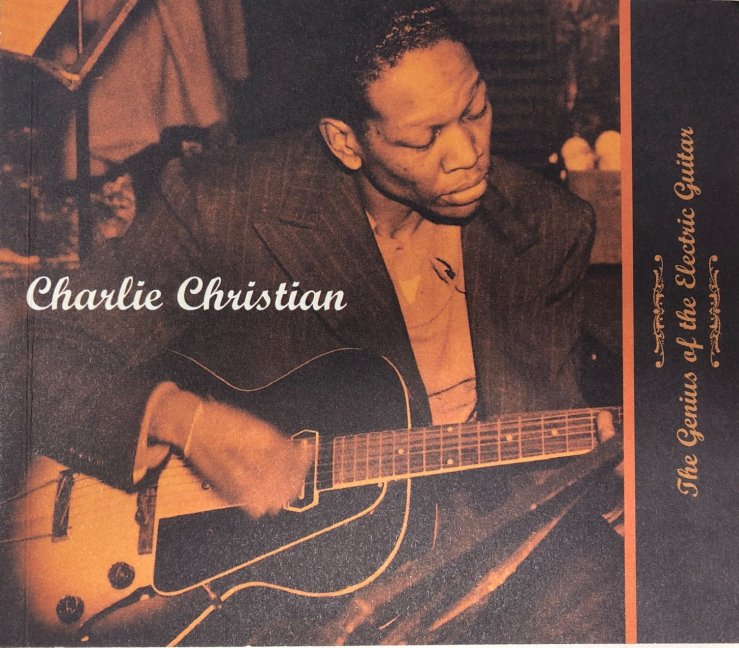
SOLO FLIGHT THE CHARLIE CHRISTIAN LEGACY |
|
|
|
CHARLIE CHRISTIANMY FRIEND
|
|
My Friend, Charlie Christian
The year was 1938. I was living in New York and playing on the NBC radio network, five nights a week. It was the coast-to-coast broadcast of The Chesterfield Hour with Fred Waring &t His Pennsylvanians, featuring the Les Paul Trio. So three times a week, lid get to play the guitar on the show and I became enormously well known in radio in those days.
One day my bass player Ernie Newton says to me:
"We've been working hard, knocking our brains out – let's go to
Chicago. Let's go out to Wisconsin, see your mom, take a couple
weeks off."
Here I am in New York, on network radio with Fred
Waring and jamming with the greatest players in the world: Art.
Tatum, Benny Goodman, Roy Eldridge, Coleman Hawkins. But all my
mother can say is "Lester, think about it." The place they were playing was like an airplane hanger, a big cavernous ballroom. A real cowboy saloon, but huge. And pretty soon we're jamming with them, having a helluva good time, when I notice this young black fellow standing down below and looking up at me. We took a break, and this fellow says to me: "Mr. Paul, could I get your autograph?" So I give him my autograph. "I play the guitar," he tells me. I say, "Well, are ya any good?" He says, "Yes, sir." I ask him his name. "Charlie," he says, "Charlie Christian." I handed him the guitar and he played a little. I says, "Jesus, you are good. You want to come up and sit in with us?" So he got up and played my guitar with The Texas Playboys. I don't know whether he even had an instrument at that time. That was the first night that I met Charlie Christian. Back in New York, not too long after that, I get a call from Charlie. He's gotten an offer to come to New York – that was from Benny Goodman – but he doesn't have a guitar. I'm about to order a new guitar from Gibson – would he like one like mine? "I'll order it for you, "I say, "and we'll have 'em both alike." The next thing I know, he's back in New York. We met at the New York Band & Instrument Company, owned by Eddie on Sixth Avenue around 46th Street. We've got the guitars that Gibson sent to Eddie Bell. I'd had the amplifier casings made of one-inch-thick maple so it wouldn't vibrate on stage. This son-of-a-bitch had like sixteen tubes in it. Now Charlie's got his guitar and I've got mine, and we're excited as hell over these. two beautiful blonde Gibson guitars. I had to go to work at 53rd and Broadway, in the same building right where the David Letterman Theater is now. So we left Eddie Bell's, carrying our guitars and amps, and walked to 53rd and Broadway. I'm gonna rehearse with Fred Waring, and Charlie's gonna take the subway to Harlem. We're standing there, and we kinda look at each other. "Charlie," I says, "my balls are about ready to fall off." "Les," he says, "this thing is so heavy, I can't even lift it anymore!" That inch-thick maple casing on the amp was killing both of us. The guitar itself, the top, was another half-inch of solid maple. We turned around and dragged it all back to Eddie Bell to send back to Gibson. And I went back to the old guitar, the same one that Charlie played that night in Tulsa. Charlie hits with Benny Goodman. He's all excited, and I'm very excited about how good he's doing. We'd go up to Minton's and jam together, swap licks - the whole nine yards. He was living uptown and I was in Queens, at 81st and Roosevelt Avenue in Jackson Heights. Charlie always was impressed with the fact that I was a technical player, a white technical player. But he was a stomper. "You only play one goddamn note," I'd tell him, "and you kill me!" "What I'm doing was so much harder than what he's doing" - that's what I thought back then. But over time, through being with Charlie, I realized how tough it is to come down on that one note in the right place, and how much more of a drive he had. He had that ability, like Lionel Hampton, to take a note, to take one "A," and just pound it into your head until it was the greatest note you'd ever heard. He didn't play beyond himself. He didn't think, "What the hell, no one's listening. Why don't I try this?" Charlie wasn't one to go out over his head. The beat came first – he locked himself into that driving sound. In 1941, I stuck my hand in the transmitter of an illegal radio station I had made in my basement in Jackson Heights. I was nearly electrocuted, and that accident ended my career for a year. While I'm in the hospital, they tell me that Charlie's in the hospital on Staten Island. I called him up, and we talked about the good times we had playing together, all the fun we had, how wonderful it was. "Les," he says, "I've got tuberculosis." 1 knew what that meant. Because in those days, if you had TB, there was really nothing they could do for you. That phone call was the last i heard from Charlie Christian. I don't know if he came out of that hospital, if he survived two or three or five months. I guess that he'd only played professionally for about five years. I heard Charlie's influence spread during his lifetime. You could hear him in Barney Kessel, in Herb Ellis – all the guys who tried to get that big, round sound. It ran through Wes Montgomery, and it runs through George Benson today. I was talking with George about Charlie not even six months ago. With all the technique they have out there, with all these guitar players - the one that wins is still the fellow that plays that one note I heard that night in Tulsa. He never lived to fulfill what he could have done, should have done. But I loved that man.
Charlie Christian was my friend. |
[ Discography Index ] [ Tune Title Index ]
|