|
SOLO FLIGHT THE CHARLIE CHRISTIAN LEGACY |
|
|
|
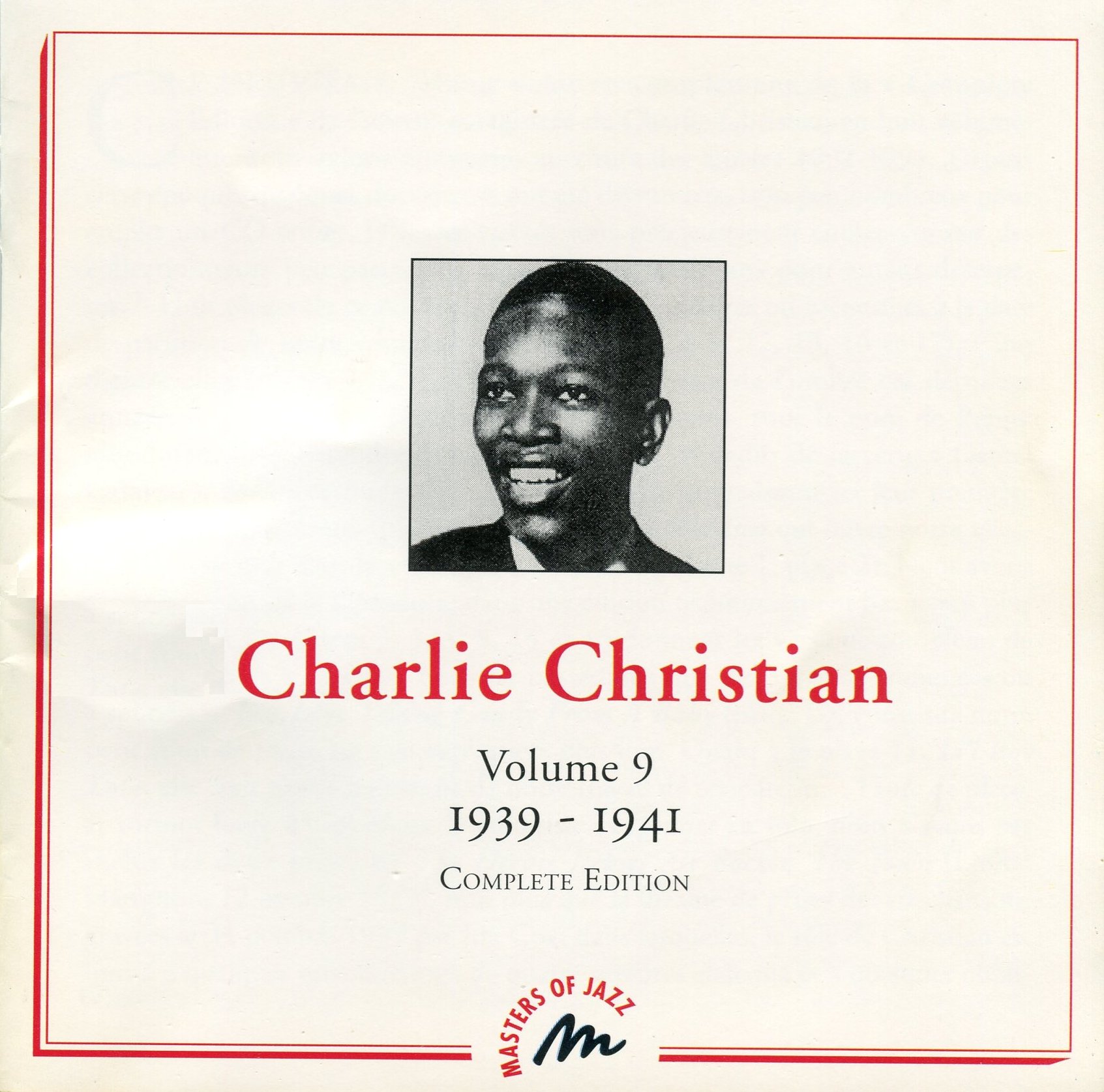
CHARLIE CHRISTIAN
MASTERS OF JAZZ / MEDIA 7
|
|
These are the Liner Notes written by Claude Carričre
“The aim of this collection is to publish all known recorded material
MASTERS OF JAZZ / MEDIA 7 Claude Carričre
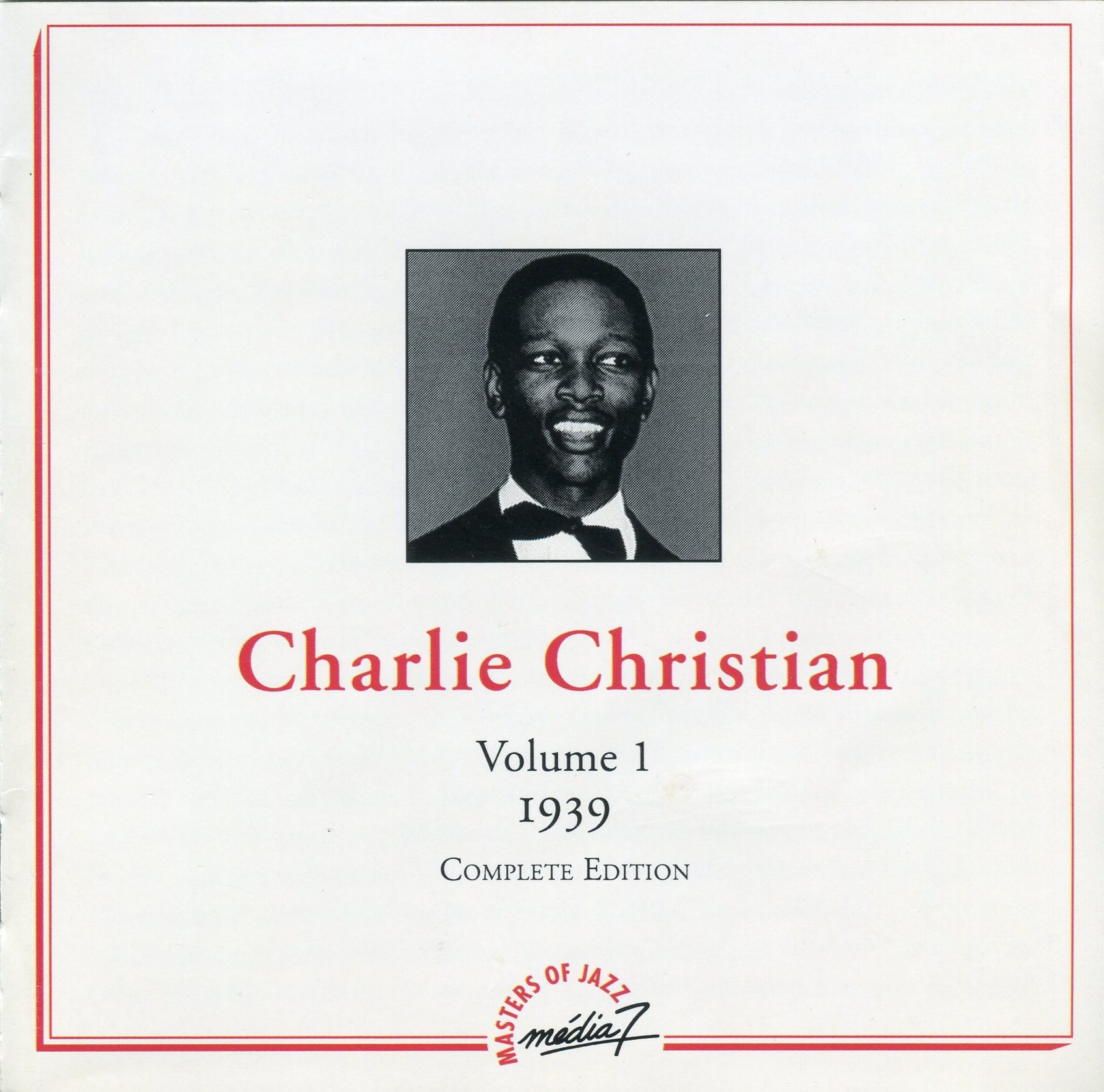
CHARLIE CHRISTIAN VOLUME 1
WRITER RALPH ELLISON remembers having known him back in 1923. During workshop lessons at Douglass School in Oklahoma City, young Charlie Christian and his elder brother used to make guitars from cigar boxes. And, before even being big enough to hold a real guitar, the kid had served as guide to his father, a blind singer and guitarist. Later, with his father and two brothers, Charlie wended his way round the streets of the city’s white middle-class area playing requests. His early apprenticeship was playing the blues and light music, while at school, Ralph Ellison recalls, they learned harmony. Certainly, the music played by the family band was much better than the money it brought in. All this was taking place, remember, in a city that often played host to Kansas City orchestras, and where all local musicians, accustomed to accompanying silent films, could sight-read. This was, too, the first golden age of radio. In such a musical environment, Charlie practised all sorts of instruments, including trumpet, piano, saxophone and double-bass (an instrument he would play in the Alphonso Trent orchestra in 1934). But his favourite would always remain the guitar, on which he appeared with the Jeter-Pillars Band from St. Louis. In this same band, from 1937 to 1938, was another guitarist, Floyd Smith, a genuine pioneer of the amplified version of the instrument. Smith would make a name for himself in 1939 when he recorded Floyd’s Guitar Blues with the Andy Kirk orchestra, a record on which his blues-drenched Hawaiian-guitar sounds became a veritable landmark in the history of the instrument. Another pioneer of electric guitar, an unsung hero, was Leonard Ware, magnificent on Sidney Bechet’s 1938 What a Dream, as well as on the three other pieces from that same session. But Charlie Christian’s real master in the domain of amplification was Eddie Durham. As reed-player Eddie Barefield once recalled when conversation got round to Charlie: “He used to come over when we went to Oklahoma City with Bennie Moten. He used to come and take guitar lessons from Eddie Durham.” At this time (1932-1933) Durham was already experimenting with amplification, and by 1935 he was using it very effectively on record with the Jimmie Lunceford orchestra (Bird of Paradise and Rhapsody Jr in May; and I’ll Take the South, Avalon and, especially, Hittin’ the Bottle in September). But it would be more reasonable to suppose that it was when the Count Basie orchestra passed through Oklahoma City that Durham, by now with Basie, first genuinely revealed the charms of amplified guitar to the impressionable young Christian. In the meantime, Charlie had toured with the so-called Territory Bands of Lloyd Hunter and Nat Towles prior to setting up his own group. Over a period of several months, Charlie Christian was destined to be a star leader on the local scene. The Pittsburgh Courier of 15 July 1939, mentioning an appearance by the band, commented: “Charlie is a wizard on the Epiphone guitar.” Pianist Mary Lou Williams had heard Charlie at Ruby’s Grill in Oklahoma City, and it was she who recommended producer John Hammond to make a detour through the city to hear him. And it was Hammond, thrilled by what he heard, who persuaded Benny Goodman to use part of the budget of his West Coast radio broadcasts to pay for the guitarist to travel to Los Angeles for an audition. Hammond knew that Goodman, on the lookout for new sounds, had tried to sign on Floyd Smith, but had foundered on the objections of Joe Glaser, manager of the Andy Kirk orchestra. All this was around the time Goodman was settling in for a residency at the Victor Hugo Restaurant near Beverly Hills. On 11 August 1939, John Hammond tells us, Charlie Christian arrived in the studio where the Goodman orchestra was in the middle of recording. Beneath a large hat, and wearing purple shirt and yellow shoes, in strolled Charlie complete with guitar and amplifier. Benny cast a cold glance from behind his spectacles, and carried on working. “The moment the session ended,” Hammond continues, “Benny prepared to leave, paying no further attention to Charlie. ‘Won’t you at least listen ?,’, I begged him. ‘He’s come all the way from Oklahoma to play for you’. ‘John, I’ve got things on my mind’, Benny said impatiently. He paused, glanced at Charlie, and agreed. ‘Okay’, he said, ‘chord me on Tea for Two.’ Charlie never had the chance to plug in his amplifier. Benny, of course, was not impressed and the audition ended. I left with Artie Bernstein, who was Benny’s bass at that time. Charlie Christian left with Fletcher (Henderson) and Lionel (Hampton) for a hotel in the Watts section of Los Angeles, a city as segregated in those days as any in the Deep South. I told Charlie to meet me in the kitchen of the Victor Hugo at 8.30, the time Goodman was to conclude his first set.” What followed has since made jazz history. While Goodman was dining, Artie Bernstein and Hammond installed Charlie’s amplifier. When the group finally filed back on stage, Benny, hitherto blissfully unaware his quintet was about to become a sextet, spied the guitarist, dressed in the same regalia as before, making himself comfortable as part of the band. Unable to react in front of the Victor Hugo’s exclusive clientele, all he could do was kick off the first number. Thinking Christian would be caught out by a tune he didn’t know, he called Rose Room. Hammond is more or less sure Charlie had never heard the piece in his life before, since it was not one that usually featured in the repertoire of black orchestras. But the guitarist, once he had grasped the melody and harmonic structure from Benny’s statement of the theme, stunned everybody by stringing together 25 successive choruses, each more inspired than the last. Goodman and Hampton, caught up in the whirlwind, then started to lay out their wares, and, by the time they had all finished, this particular Rose Room had lasted no less than three-quarters-of-an-hour! Destiny had thus shaped the career of the greatest
guitarist in jazz history: Charlie Christian would remain with Benny Goodman for
the rest of his life. But, as destiny would also have it, Charlie had no more
than three short years to live.
The earliest recorded testimony we have of Christian’s work
is a rendering of Flying Home, a Lionel Hampton riff tune that the
vibraphonist’s successive big bands would turn into an indestructible hit. This
piece will crop up a good ten times in the present series, yet only a single one
of these performances was actually recorded for commercial issue. This first
version, which offers an entire 32-bar chorus from Christian, plunges us direct
into his own special universe. Recorded only a week after that first dramatic
meeting between Charlie and his new boss, this solo displays all the essential
characteristics of the great guitarist’s art: melodic invention, rhythmic
imagination, precise execution, perfect logic and a solid, laid-back sense of
swing. This is indeed one of the finest versions of this piece, unfortunately a
little spoilt by barely satisfactory recording quality (of which there is worse
to come!)
Like so many great jazzmen (I am thinking especially of Art
Tatum, or Nat King Cole and his Body and Soul), Christian also knew how
to dispense with improvisation and serve up carefully prepared solos, just as he
did with Stardust on the Goodman radio broadcast of 2 September
1939. This immaculately polished performance also highlights — as early as the
second track of this opening volume — a rare aspect of Charlie’s work: the
rendering of a piece almost entirely in chords, in this case superimposed minor
triads that he “glisses” a semi-tone (a technique, Gunther Schuller reminds us,
familiar to Hawaiian guitarists, and subsequently a favourite trick with
Nashville studio players). But Charlie does play the middle part in single
notes, an in so doing quotes Pretty Baby, a touch regularly copied over
the years by Lionel Hampton and his men.
Indeed, it was with Hampton that Christian took part in his first “official” studio recording. On 11 September 1939, the vibraphonist assembled a group of star saxophonists, plus Dizzy Gillespie, backed by a superb rhythm section at the heart of which was the acoustic guitar, authoritative and supple, of the young Charlie Christian. The swing this section gene-rates, more pronounced than that of the smooth-running Basie team of the day (Freddie Green, Walter Page and Jo Jones), noticeably stimulates the soloists. The point is admirably illustrated by the single performance included here, One Sweet Letter from You, on which Charlie serves up a delight-fully executed, unamplified, chorded obbligato behind the leader’s vocal. At no time does he get in the way of the voice, but instead exploits each pause for breath by inserting a phrase linking the one just gone to the one to come. By which point of the performance we have already enjoyed the added bonus of a splendid solo from Coleman Hawkins. This piece is the only one from this session on which
Christian is heard playing anything other than rhythm, but the other three
(including When Lights Are Low, a pure masterpiece) will in any case be
made available in the Masters of Jazz sets devoted to Lionel Hampton and Benny
Carter.
The three performances that follow were recorded in Minneapolis on the occasion of a visit from the Benny Goodman orchestra in early autumn 1939 (although it was long believed these sides dated from March 1940). These recordings were made by a disc-jockey, probably for broadcast use. Whatever the motive, they offer us a wonderful opportunity to hear Christian at length: four 32-bar choruses on I Got Rhythm (two separate takes seem to have been spliced); 64 bars on Stardust, and 64 bars, then another 32, on Tea for Two. Adapting quickly to his colleagues for the day (true, Jerry Jerome was a member of the Goodman big band, but the rhythm section was local and I have serious doubts about the claimed presence of Oscar Pettiford on bass), Charlie gives free rein to his imagination. On I Got Rhythm, a little in the manner of Lester Young (cf. Oh! Lady Be Good, Basie 1936), he at first keeps his style relatively simple, using straightforward riff patterns; but, when he arrives at the bridge, he suddenly lets fly, launching upon a series of long, daring phrases that no other guitarist of the day would have dreamed of attempting. A genius at work! Stardust is equally eloquent in that
Charlie’s famous chorded chorus — always basically the same, yet full of subtle
differences from one version to another — is here preceded by a supremely
elegant chorus played entirely in single notes, an alternation of clean,
uncluttered lines and astonishing flurries (especially bars 9 to 16). Tea
for Two, on the other hand, reveals another aspect of Christian’s
greatness: his instrumental mastery at livelier tempos, and the implacable
authority and coherence with which he expresses his generally very long musical
ideas. Note especially the bewildering lines he develops from the outset of the
second chorus of his opening solo, and again during the final 16 bars of his
second solo. And the Christian thirst for action is evident from the way he
picks up his rhythm-section role the instant his solos end.
A few days later, the Benny Goodman sextet made two studio recordings of Benny’s Flying Home. The first was for commercial issue, whereas the second, rechristened Homeward Bound was released as a V - Disc six years later. The overall pattern of each version is the same, but the guitar solos reveal notable differences. The first — reposing firmly on the beat — is more airy and more logical, and consists of short phrases punctuated by a clarinet-and-vibraphone riff; the second, more loose-limbed, once again displays Charlie’s liking for tearing loose at the bridge, and the lines are much longer. The comparison proves fascinating, but the first take although less adventurous, turns out the more polished of the two. At the same session, they also recorded Rose Room, the piece with which Benny had trapped Charlie at that infamous first audition. But the guitarist’s chorus here is one of the most accomplished he has left us, a poised, inventive masterpiece full of surprises and taken at a loping tempo ideal for the elaboration of clean, logical ideas. The very mobile harmonic structure proves an obvious inspiration to Christian, and you must on no account miss the magisterial phrase he improvises at bars 12 and 13 after making a superb descent into the low register during the preceding bars. The final piece from this sextet-session is Stardust
once again complete with the familiar chorded solo now the guitarist’s warhorse.
The tempo here is slower, and the whole atmosphere calmer. Hampton, too, takes a
very attractive solo, while the leader remains content just to take care of the
theme statement.
The sextet’s Carnegie Hall interpretations of Flying
Home and Stardust differ little from the studio
performances of four days earlier. But you will notice Charlie’s solo on
Flying Home does flow better than on the Homeward
Bound version from the studio session.
This concert also brings us a first rendering of the very
pretty Eubie Blake tune, Memories of You. It offers no more than
an 8-bar bridge from the guitarist, yet within those few seconds Charlie
displays his immense authority. He weaves two superb phrases, then pauses at the
fourth bar before fashioning a bold line in the lower register that completes
the bridge and leads direct into Goodman’s conclusion of the theme. So many
riches in so short a space of time leave one speechless — and, if one happens to
overlook the reality that in this group Christian was simply one soloist among
others, even a little frustrated.
The Rose Room that follows, taken from a
broadcast from New York’s luxurious Waldorf Astoria, shows some radical
differences from the studio version of a week earlier. Here is yet further
testimony to Charlie’s creativity, a relaxed solo contribution that to a certain
extent presages Johnny Hodges’ subsequent effort on Duke Ellington’s In A
Mellotone (cf. bars 5 to 8, for example). Unfortunately, Fletcher
Henderson’s over-recorded piano pumps away laboriously on a recording that is of
poor technical quality.
Lionel Hampton, Charlie’s regular companion in the Benny
Goodman ranks, invited the guitarist to take part in another of his recording
sessions, this time on 12 October 1939. But, once again, he neglected to let him
solo at length. However, with a mere three-quarters of the second chorus to go
at (trumpeter Red Allen steps in somewhat clumsily for the bridge), Charlie
swept along by the best drummer he would ever find by his side, Big Sid Catlett,
exploits the opportunity with stunning effect. One has the impression, both from
soloist and rhythm section, that swing can grow no more intense than this.
Flying at this altitude, Charlie obviously feels very much at home, bursting
with self-assurance and excitingly inventive. Fortunately, the recording quality
here does him justice. Note that the three other sides from this session will be
included in the Masters of Jazz series devoted to Lionel Hampton.
On 14 October 1939 came the first recording by Benny
Goodman’s new sextet of AC-DC Current a blues in G co-authored by
Christian, but on which he manages to contribute only three times four bars. A
great pity, for we can imagine what he might have made of such a marvellous
spring-board as this, with its four unaccompanied bars as launching-pad for each
solo. Charlie’s first two interjections are amusing and clever, and his backing
of good vibraphone and clarinet solos is full of swing.
On the fifth (and final) Flying Home of this
first volume, the guitar solo begins with the same rhythmic phrase as on the
V-Disc Homeward Bound version of the piece, but the rest is
different. Note the insistent, very swinging repetition of one particular note
between bars 25 and 28.
The programme continues with the first recorded rendering
of Soft Winds, on which Christian plays a purely orchestral role.
Cleverly exploiting the resources of amplification, on the theme statement he
holds the notes in the same way as Goodman. He repeats the process when guitar
and clarinet, playing an octave apart, fashion a boogie-woogie motif in sup-port
of Hampton’s solo. The Charlie Christian presence is quite simply indispensable
to a performance such as this.
Different from the earlier version, Memories of You
is none the less beautiful, and this despite the poor condition of the copy at
our disposal. While Hampton begins his solo with a clumsy phrase that leads him
to a B natural on which he unwisely insists, the guitar bridge makes us regret
Christian was denied a full chorus, all the more so as the
‘A’ phrase of the
AABA structure is harmonically more interesting than the
‘B’.
The closing track brings us Charlie Christian in a completely different context. Here, the leader is legendary blues singer Ida Cox, one of the best in the business. She is accompanied by an all-star band whose job is to support, not to solo. Charlie nevertheless manages to produce some lovely touches, full of blues feeling, and the exceptionally faithful recording quality captures the sound of his guitar better than ever. For reasons of both space and content, however, the remaining sides from this October 1939 session do not belong here. But rest assured, Volume 2 holds a number of other musical surprises in store. Charlie Christian’s guitars: After the Epiphone mentioned in the Pittsburgh Courier of 15 July 1939, Christian used a Gibson ES-150 (introduced in 1937), the ES-250 (manufactured as from 1939), and the L5 acoustic blond. Based on photo-graphs he possesses, Claude Ventura, who was kind enough to supply us with this information, has identified at least six different guitars. Claude Carričre Philippe Baudoin comments:
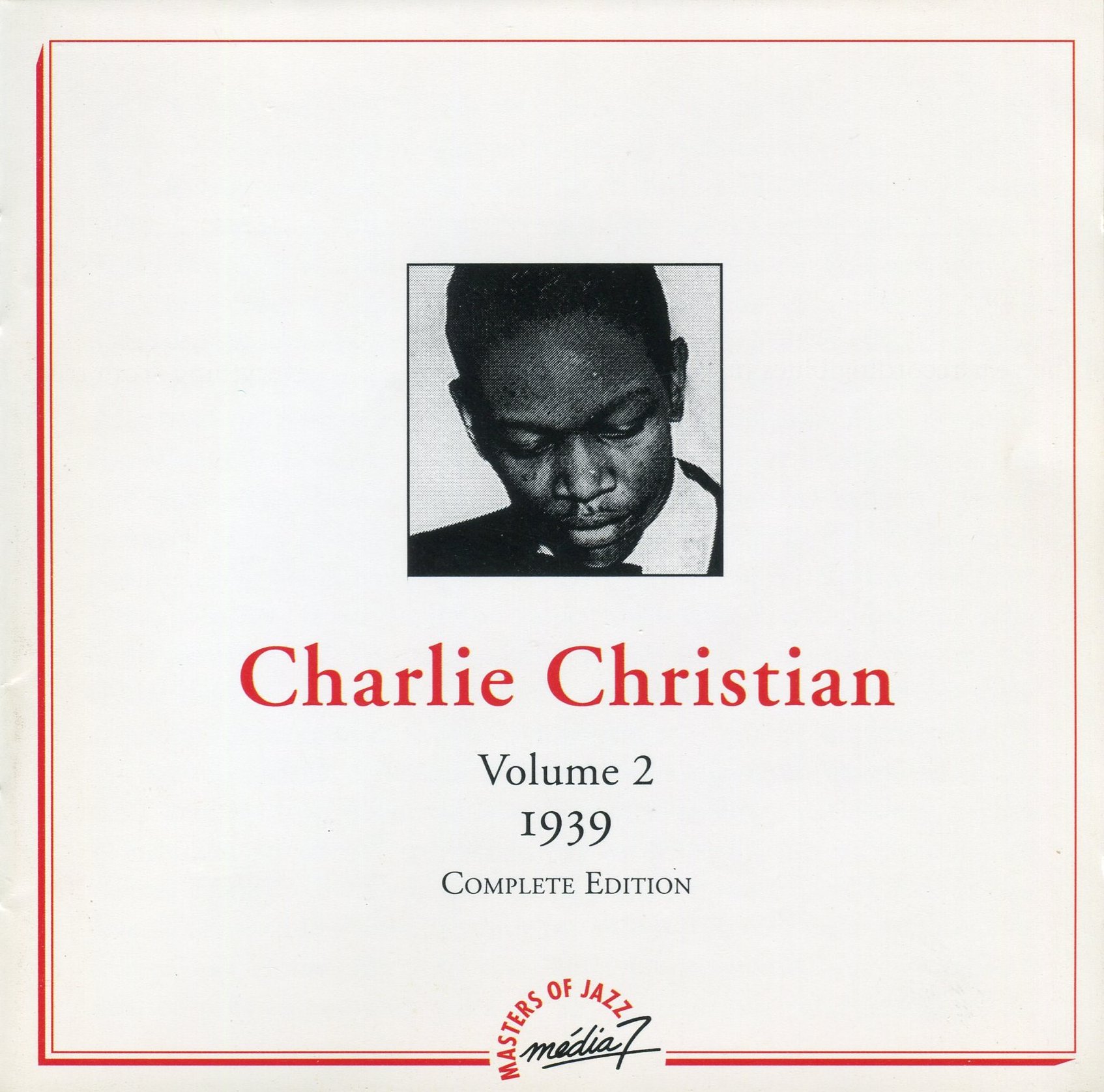
CHARLIE CHRISTIAN VOLUME 2
BARELY FIVE MONTHS have passed since Charlie Christian joined the Benny Goodman sextet, and their first recording together on a radio broadcast in Hollywood on 19 August 1939. That historic document opened the initial volume of our ‘Complete Edition’ of Charlie Christian, and this second collection of recordings will take us in twenty-one mouth-watering stages from 4 November to 24 December 1939. Not even two months, yet how packed with riches, within a recording career destined to last less than two years! But those 22 productive months of Charlie’s life would leave their indelible mark on the history of jazz, transforming the amplified guitar into one of the music’s key instruments. Benny Goodman’s role in events can scarcely be over-estimated. A demanding bandleader and insistent perfectionist, in 1939 he was on the lookout for a new sound for his small group. Hitherto, the line-up had consisted of clarinet, piano, vibraphone and drums, but on 10 January 1939, for a radio broadcast from Broadway, he had experimented by adding bass and amplified guitar, this some seven months before Charlie Christian’s arrival on the scene. On guitar that day was Leonard Ware, who three months earlier had recorded four sides on amplified guitar with Sidney Bechet. But Goodman was still far from convinced about the benefits of this “swing electric guitar,” which, it’s true, he had failed to integrate into the overall texture of the music. So the search continued. On another radio programme the following 9 May, Benny used a drumless quintet for a performance of Old Fashioned Love on which his then guitarist, George Rose, used a pocket-size electric instrument; but it produced weird results, and Benny found himself back at square-one in his quest for a new sound. Then came Charlie Christian’s first outing with the group, and, instantaneously, the sound Benny had been looking for. He now fronted a sextet that would set a standard for a whole generation of jazz players. Here, however, it is not Goodman’s ambitions that concern us, but rather the amazing solo talents of a guitarist whose innovations coincided with one of the major turning-points in jazz history. In this respect, we must surely draw a parallel with Jimmy Blanton, a double-bassist of undisputed genius, who cut his first records with the Duke Ellington orchestra on 14 October 1939, and who in less than two years revolutionised the role of the instrument. A parallel all the more striking in that not only did both these young artists make jazz history, but both lived such tragically short lives. Christian was born on 29 July 1916, and Blanton in October 1918. Both died in 1942, victims of tuberculosis: Christian on 2 March, and Blanton on 30 July. But now to the music.
We are in New York, and it is 4 November 1939. Shivers, which we shall hear a little later in its “official” versions, appears here for the first time, in a smooth-flowing, admirably swinging radio recording. Taken at an infectiously bouncy tempo, it has Charlie Christian wonderfully present throughout, from the introduction right up to his final riff beneath the closing ensemble. His solo — the entire 32 bars of the third chorus, minus the eight-bar bridge taken by Goodman — comprises a series of simple phrases, each delightfully placed. Most striking of all, the phrase he invents as he re-enters after the bridge bears the mark of an outstanding modern musician.
On 22 November 1939 the group made studio recordings of three pieces, two of them, Memories of You and Soft Winds, already familiar to us from their radio versions (cf. Volume 1). The eight short bars from Charlie on the bridge of Memories differ significantly from one take to the other: the first restrained, the second more adventurous. The brevity of Charlie’s intervention is all the more regrettable in that the earlier version of this ideal showcase also denied him a complete chorus. In addition to which, Soft Winds, as on the previous occasion, casts Charlie in the limited role of rhythm accompanist. Nevertheless, what verve and presence! Just listen to the boogie-woogie figure he weaves behind Lionel Hampton’s solo, and his witty interjections on the ride-out riff. On Seven Come Eleven, Christian, as so often on these 32-bar compositions of AABA structure, restricts himself to a series of rhythmic phrases on the A passages, then tears loose on the bridge, giving full vent to his remarkable harmonic sense. Even so, this particular solo by no means ranks among his best, and Goodman himself is unusually stiff. A great pity, since this clever Christian original offers immense opportunities. Incidentally, the title started out as Roast Turkey Stomp, a Lionel Hampton suggestion inspired by the period of Thanksgiving during which the recording was made.
Indeed, that particular 22 November was a busy day. The sextet having done its bit, it was now the turn of the big band. Three of its four cuts featured singer Mildred Bailey as invited guest, but the fourth provided the opportunity for Charlie to produce his first recorded solo with the full orchestra. Fats Waller’s Honeysuckle Rose, in a Fletcher Henderson arrangement in the key of D flat (Fats had written it in F), subtly focuses the spotlight on the three soloists: Goodman, trumpeter Ziggy Elman and Christian. Here the guitarist is allocated a full 32-bar chorus, and he uses it to develop a remarkably fluid improvisation over discreet, swinging riffs from the orchestra. On no account miss the phrase he concocts at the beginning of this final eight bars, a perfect musical transposition of the steps of a great dancer.
The version of Seven Come Eleven the sextet served up at the Waldorf Astoria just three days later is noticeably more relaxed and inspired than the studio performance. In their backing of the guitar, the rest of the group remain content to repeat the riff from the theme statement, and Hampton refrains from superimposing a separate riff as he did on the studio version.
The first airing of AC-DC Current appeared in Volume 1. The second, included here, comes as an added reminder that, with a vibraphone and amplified guitar in the line-up, this was an electric band! Most discographies list two separate versions from this period, one recorded on 27 November and the other on 2 December 1939, whereas careful listening reveals they are one and the same, with dubbed-in echo and applause on the second serving. Although Charlie is granted only modest solo space (three times four bars), he stamps his firm imprint on this rendering. Especially impressive is his acrobatic opening break at the beginning of the second chorus. Hampton too shows a lot of imagination here, and the whole riff-propelled performance bounds along in a spirit of great jubilation.
In December 1939, Fletcher Henderson, tired by the overload of his twin function as arranger and pianist in the Goodman orchestra, was replaced by a talented, still little-known newcomer by the name of Johnny Guarnieri. A descendant of an illustrious Italian family of violin-makers called Guarnerius, Johnny had hitherto played only in orchestras not generally appreciated by the jazz community: principally those of George Hall and Mike Riley. But Goodman led the way as everybody quickly recognised his immense qualities as a jazz player and band pianist. And Guarnieri himself waited no longer than his first broadcast as member of the Goodman camp on 16 December to come out and solo, something Fletcher had been more reluctant to do. (Incidentally, Benny for some time persisted in calling his new pianist Fletcher, perhaps because he experienced difficulty trying to pronounce his real name!) The result was Dinah, a recording all the more precious in that the sextet never produced a studio version. Christian, urged on his way by Guarnieri’s no-nonsense but not unsubtle piano, takes a 32-bar chorus noteworthy for its total rhythmic abandon and teasing flashes of humour. A pure delight!
Four days later, in the Columbia studios, the sextet cut three sides, Shivers, AC-DC Current and I’m Confessin’. The first two offer few surprises. We are already familiar with the material, and their structure is the same. The solos, of course, do throw up some differences, but tend to find the gods resting somewhat comfortably on their laurels. Of interest, however, is that we now have two takes of Shivers at our disposal, and, even though the first is incomplete, Christian has completed his solo before it is interrupted. As usual, the guitarist sees his always extended ideas safely through to their resolution; and he still turns is some masterly work, especially on his last eight bars of the second take, a superb, intensely swinging riff repeated twice, followed by a conclusion leaving absolutely no room for argument. But the gem of this session is I’m Confessin’, inexplicably rejected and condemned to the archives. Buoyed by this pretty melody, superbly interpreted by Louis Armstrong back in 1930, Goodman, Guarnieri, Hampton and Christian cruise along nicely without looking for complications. Yet, as Jan Evensmo has pointed out in his “Solography,” the guitarist’s audacious use of intervals places him right in the front line of the avant-garde ranks of the day. Which inevitably brings to mind Lester Young, an artist about to enter our story.
It is 24 December 1939, and as a Christmas treat John Hammond has laid on a second edition of his “From Spirituals to Swing” concert at New York’s Carnegie Hall. For the occasion Goodman has invited Fletcher Henderson to rejoin the sextet, and the resultant Flying Home and Memories of You must rank among the best versions the group has left us. The atmosphere is happy and laid-back, and there are many unforgettable moments. Particularly memorable are the bridge of Charlie’s solo on Flying Home (a theme originally Christian’s, John Hammond insists), which he crosses in one single breathtaking run; and his closing phrase on the bridge of Memories of You, a veritable monument of melodic and harmonic invention that within the space of a few magic seconds seems to anticipate several decades of jazz. This brief passage should in itself suffice to convert any doubters of Christian’s greatness. Charlie remains at the same dizzying altitude on Honeysuckle Rose, serving up an even better solo than the one on the big-band studio version. Indeed, this Christmas Eve party seems to have inspired the whole group, with Goodman himself blowing a touchingly sensitive solo on Memories of You. The rhythm section flies high throughout (although the other two pieces the sextet recorded that night are not included here, as Christian does not emerge from his role of sideman).
But the party is not yet over, and ultimate bliss is still to come. A quintet drawn from the ranks of the Count Basie orchestra (Buck Clayton on trumpet, Lester Young on tenor-sax, and the dream rhythm section of Freddie Green, Walter Page and Jo Jones) has decided to invite a guest: Charlie Christian. It is as if the guitarist has been reunited with his true family, rediscovering the Southwest of his early youth. Indeed, Oklahoma City had been the home base of Walter Page’s Blue Devils, a group with which Lester Young had put in a couple of stints, the first in 1929 and then again i n 1931. Charlie had heard Lester with those Blue Devils down in Oklahoma, and his style reveals he had listened to him very carefully. Lester’s linear playing, very different from the Coleman Hawkins vertical approach to chords, proved a profound influence on the impressionable youngster, whose adoption of amplified guitar enabled him to produce long sequences of equal notes. On the stage of Carnegie Hall that night, one thing becomes eminently clear: Charlie and Lester are speaking the same language. From the very first notes of Paging the Devil, the magic casts its spell. And, in addition to this first-ever recorded partnership with Lester, we also have the thrill of hearing Charlie backed by the most redoubtable rhythm guitarist in the history of jazz, Freddie Green. (Charlie later presented Green with an electric guitar, but this strictly acoustic player never touched it, at least not in public! ) It is interesting to note that Buck Clayton chooses this unique occasion to slip into a Louis Armstrong mould, Hot Five manner. And that Paging the Devil offers magnificent proof of Charlie Christian’s ability as a blues guitarist. Charlie’s two choruses on Good Morning Blues maintain the same inspired level: the first, in the low register and dramatically restrained, perfectly prepares the way for the second, forceful and exuberant. But, despite Lester’s encouraging flights of fantasy, Charlie is much less at ease on Way Down Yonder in New Orleans. Apparently distracted, perhaps by some amplifier problem, he messes up the entry to his solo, yet nevertheless manages to right himself with typical professional aplomb.
The jam session that brings this historic concert to a close unleashes a whole phalanx of soloists for a Lady Be Good which time considerations dictated should be short, but which nevertheless lasts nearly ten minutes. A few of the assembled troops manage to have their full say: principally Count Basie, a magnificent Lester, Charlie (with two good choruses, plus the bridge on the ride-out) and trumpeter Harry Edison. J.D. Smith, a journalist with Jazz Information, states in the issue dated 29 December 1939 that three pianists took part in these closing fireworks: Basie, Joe Sullivan and Pete Johnson. After submitting the evidence to the scrutiny of some highly skilled ears, we would confirm those three names in that order and advise you to forget all previous attempts at identification. Other reports talk of three bassists on stage, among them John Kirby, while Hampton is said to have tried in vain to get on drums. Such fascinating tales seem to us far more appealing than exaggerated cries for accuracy at all costs! After all, our prime objective here is not to give a history lesson, but to focus on the genius of Charlie Christian, whose dazzling exploits we shall be following in subsequent volumes. Claude Carričre Philippe Baudoin comments:
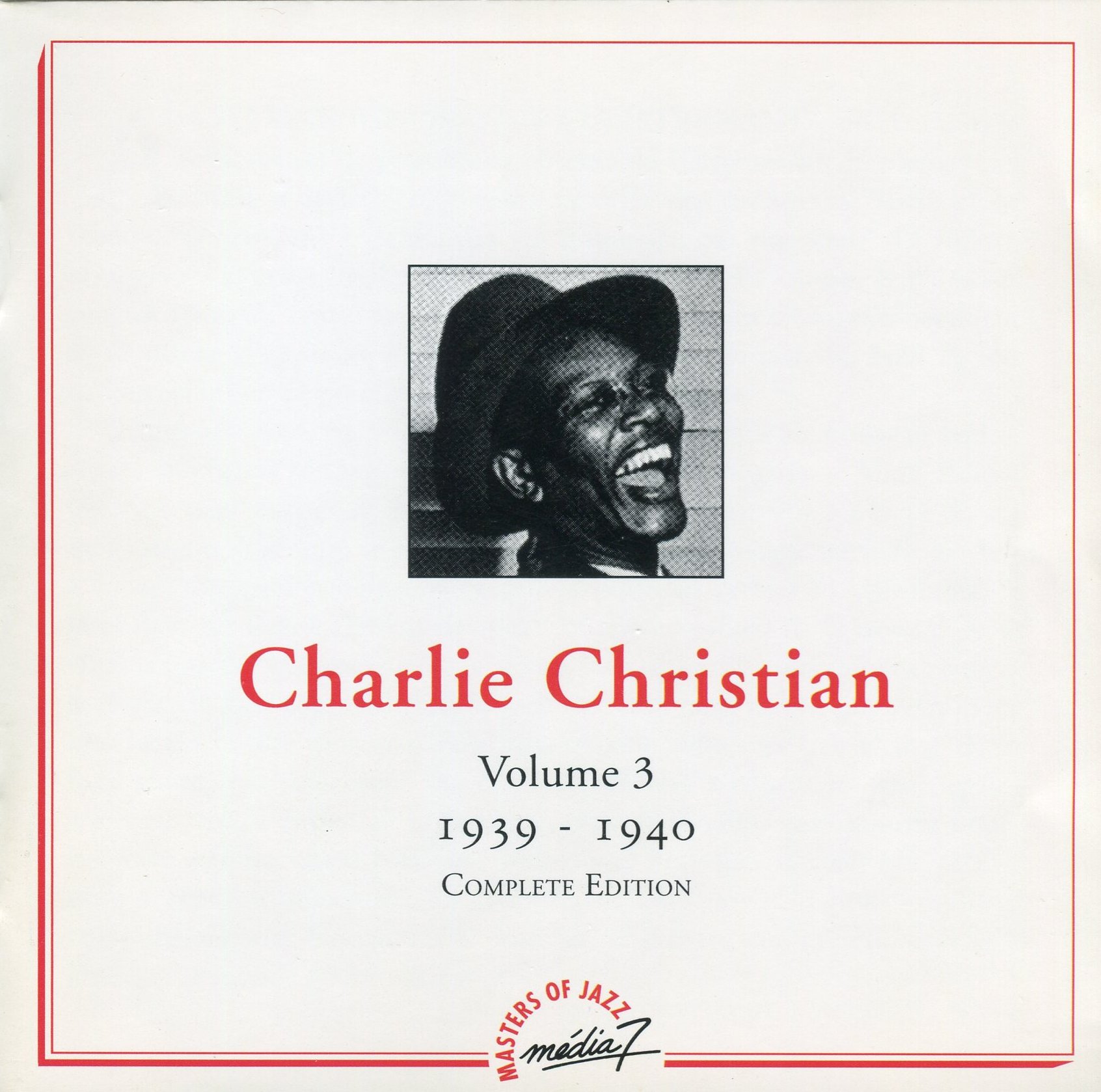
CHARLIE CHRISTIAN VOLUME 3
“WITH AN APPALLING IGNORANCE of the effective use to which they could put the instrument, most leaders, including those in the radio and movie studios, have demanded a guitarist who can fiddle, arrange, or pick his teeth walking a tightrope every other chorus. The fact that he might have been truly an artist on the guitar was negligible. And arrangers seem either to have neglected to learn anything about the guitar or else have found that arranging for it is beyond their ability.” “Electrical amplification has given guitarists a new lease on life,” Charlie Christian added, and after making a few complimentary comments about three of his colleagues — Allan Reuss, Georgie (sic) Barnes and Floyd Smith — he went on: “Needless to say, amplifying my instrument has made it possible for me to get a wonderful break. A few weeks ago I was working for beans down in Oklahoma and most of the time having a plenty tough time of getting along and playing the way I wanted to play. So take heart, all you starving guitarists. I know, and so does the rest of our small circle, that you play damned fine music, but now you’ve got a chance to bring the fact to the attention of not only short-sighted leaders but to the attention of the world. And I don’t think it’ll be long before you’re feeding your stomach again as well as your heart. Practice solo stuff, single string and otherwise, and save up a few dimes to amplify your instrument. You continue to play the guitar the way it should be played, and you’ll make the rest of the world like it.” So propounded Charlie Christian in Down Beat magazine in December 1939. He evidently held some very firm ideas on the role of his chosen instrument and believed in expressing them bluntly, even though Barney Kessel, who had been lucky enough to spend three days in his company, had found him relatively uncultivated and of limited vocabulary: “He didn’t express himself as well with words as with his music, but he held very definite opinions.” Certainly, Charlie’s article showed remarkable foresight: under his influence, the solo guitar was going to become, and to remain, one of the leading instruments in jazz, thanks principally to the amplification of which he had proved such a brilliant pioneer and torch-bearer.
To launch this third volume of the first-ever complete edition of the works of Charlie Christian, a series set to run to eight volumes, we are going to go back in time three weeks to 2 December 1939 to pick up on a version of AC-DC Current which, in the text to Volume 2, we claimed did not exist! But, thanks to the tireless efforts of Jean-Claude Alexandre, with valuable assistance from Patrick Zemb, we now know better. This version is much in the same mould as before, with everybody apparently taking the same immense pleasure in executing the numerous breaks that characterise this exciting piece. Christian comes in solo for only three four-bar contributions, but within that limited space his playing emerges as by far the most original.
With Track 2, we return to normal chronology: the previous volume having left off at 24 December 1939, here we are now, only six days later, at 30 December. Which leads us to reflect on the short period of time covered by the two preceding volumes, a mere four months. The explanation for this lies in the abundance of material resulting from the immense popularity of Benny Goodman, then the undisputed King of Swing, who not only recorded frequently but was constantly carried by radio stations. Indeed, the present version of Pick-A-Rib, unfortunately in fairly poor condition, stems from a radio broadcast, and offers us a superb guitar solo — two fluent choruses of laid-back, swinging blues. A piece already recorded commercially by the full Goodman orchestra, it this time receives the sextet treatment. The title refers to a 52nd Street restaurant run by Benny’s bassist brother, Harry Goodman, who had given up his place in the orchestra to take care of his business. Harry himself, today living in retirement on the French Riviera, was kind enough to confirm this account of events.
Another performance emanating from a radio broadcast, Till Tom Special, a piece the sextet would record in February 1940 with Count Basie on piano (cf. Track 5), elicits a 32-bar contribution in minor mode from Charlie, a contribution remarkable for its laid-back rhythm and magisterial swing. The riff behind Lionel Hampton’s vibraphone solo is none other than the Eddie Durham theme premiered by Basie in 1937, and recorded the following year by Goodman, under the title of Topsy.
On 7 February 1940, Christian, after a career of less than six months in the public eye, found himself in a New York recording studio surrounded by a whole host of jazz stars of the day, the winners of Metronome magazine’s second readers’ poll. Charlie does not solo on King Porter Stomp, the first of the two pieces cut at this session. But on All Star Strut he gladly grabs his allocated ration of one 12-bar blues chorus, the same as everybody else, sandwiched between the equally brief contributions of two eminent elders, Benny Carter and Jack Teagarden. As luck has it, we possess no fewer than three takes of this particular piece, and therefore three, very different, versions of Charlie’s solo. Our preference goes to the third, but Take 2 does have two interesting features: the guitarist fluffs a note, an event so rare that it merits a mention; and he launches his solo with a riff destined to turn up again over a year later in the final chorus of Air Mail Special.
That same day, in the same Columbia studios, Benny Goodman cut three sides with the big band, then two more with the sextet. Exceptionally, the chair of regular pianist Johnny Guarnieri was taken over by none other than the great William “Count” Basie! A Count Basie we hear playing an introduction on Till Tom Special excised from previous LP and CD reissues, a mystery we have still not succeeded in elucidating. This theme in minor mode, of which we heard an initial version on Track 3, gives Charlie an opportunity to record yet another miraculously poised, airy, swinging solo, 24 bars of a chorus to which Count Basie contributes an eight-bar bridge of equal rhythmic intensity. On the two takes of Gone With “What” Wind, a title no doubt intended as a light-hearted reference to the recently released film “Gone With The Wind,” Basie and Christian are again in sparkling form. A blues taken at a bouncy tempo, this piece gives the Count a chance to lay on us some of his timeless piano licks, already familiar from his own recordings of the day. The right hand serves up some typical boogie figures, while the left merely hints at the boogie bass line, with Basie preferring to ride along on the implacable tempo laid down by Christian. On both takes, Charlie develops two single-note choruses into which he does not hesitate to intersperse, between two brilliantly executed runs, the tonic of the chord played over and over again in the manner of the renowned “Texan tenors.” Two further details also merit particular attention: Charlie’s wonderful backing to the vibraphone solo, and Basie’s remarkable comping throughout, the work of a truly top-class band-pianist.
Following these two studio versions, we have a third rendering of Gone With “What” Wind, this time by a sextet in which Johnny Guarnieri has returned to the piano chair, and graced by a Charlie Christian solo totally different from the previous two. On this 19 March 1940, the Goodman aggregation had just reassembled after a two-week break during which the bandleader had gone off to Hot Springs, Arkansas, for treatment to his sciatica. Now all set to take up a residency at Los Angeles’ Ambassador Hotel, the clarinetist would begin a series of recordings for Columbia made in the Californian studios of the World Broadcasting System. The letters of transmittal accompanying the express shipment of the acetates to Columbia in New York indicated the actual dates of recording, generally six to ten days earlier than the dates usually assigned. Hence, the first of these sessions, normally given as 10 April 1940, in fact took place on 3 April.
That day, the sextet cut two sides, The Sheik of Araby and Poor Butterfly. On the first piece, the guitar solo, made up of several segments of varying lengths, holds numerous surprises in store (especially bars 11 to 13). The very brief solo Charlie serves up on the second piece, however, leaves us very much in a mood of expectancy.
Just three days later came yet another sextet version, again from a radio broadcast, of Gone With “What” Wind, a version that goes beyond all the previous three by ending with a brand-new, infectiously swinging riff. Unfortunately, there is a fractional break in sound during the piano solo that we have not been able to rectify, and it rather disconcertingly throws us out of time. Luckily, however, both guitar choruses are one-hundred-per-cent intact.
The second of Goodman’s Californian studio-sessions, which took place on 10 April 1940 and not the usually indicated 16 April, brings us two more quality performances, I Surrender Dear and Boy Meets Goy. The first, a pretty melody that Louis Armstrong had been one of the first to popularise back in 1931, offers us a 16-bar solo from Christian nothing short of a mini-masterpiece: of perfect structure, striking serenity, immense harmonic richness, and delectable sonority — a sonority approaching that of an acoustic guitar, except for the sustained notes made possible by amplification. Charlie is less inspired on Boy Meets Goy (a title conjured up by John Hammond, much to the consternation of the publisher, who would have preferred either of the other two titles of this same blues, Grand Slam or Boy Meets Girl), but the guitarist does nevertheless swing furiously, both on his solo and when he comes in behind Hampton (just listen to his entry at bar 5). He no doubt felt relieved that his solo is not hampered by the boogie-woogie figure served up behind the clarinet and piano solos.
The version of The Sheik of Araby played by the sextet live on radio two days later knocks the commercial recording of 3 April right out of sight. The guitar solo finds Charlie alternating long phrases (bars 8 to 15) with short, breathtakingly imaginative, diabolically swinging flurries (bars 1 to 4, and 19 to 21) that he launches with prodigious rhythmic daring. This rendering is brought to a conclusion without the four-bar exchanges of the earlier version.
Soft Winds, originating from a broadcast at the same Cocoanut Grove the next day, appears here despite the fact that Christian is given no solo space. His very presence in the rhythm section makes such an impact, however, that inclusion of this piece seemed imperative.
Just as we also felt it necessary we should include a third version, from 26 April, of The Sheik of Araby, a document that has suffered the irremediable ravages of time, but on which a break in sound luckily avoids the guitar solo, a joyful, swinging excursion that bears comparison with that of 12 April.
Charlie Christian’s next solo outing to be captured on record did not take place until just over a month later, during a radio broadcast from San Francisco on 28 May 1940. The sextet serves up another version of Charlie’s own riff-tune, Seven Come Eleven, which had made its first appearances in November 1939 (cf. Volume 2). The guitarist, enjoying greater freedom than on either of the previous versions, takes a full 32-bar chorus, and, as tended to be his wont in such circumstances, it is on the bridge that he really breaks loose.
The final track of the present volume presents a Goodman composition that would not be recorded officially until 11 June 1940. Six Appeal is the label attached to a piece in minor mode that, like its title, turns out just a trifle plodding. Charlie nevertheless makes full use of the opportunity to work on a phrase he would again pull out during the studio recording a week later. And it is that recording that will open the next chapter of our story. Claude Carričre
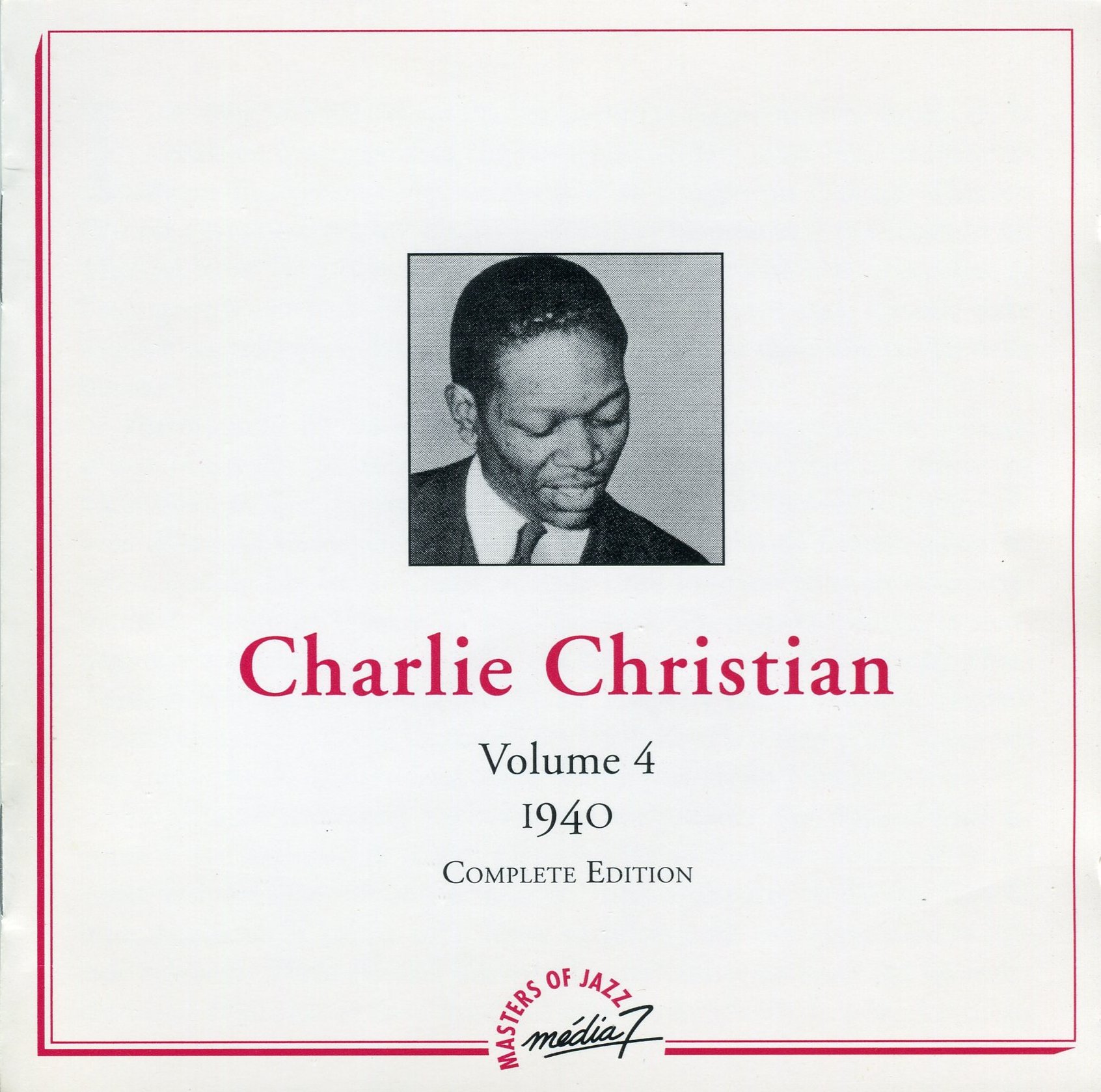
CHARLIE CHRISTIAN VOLUME 4
THE FIRST ALERT, those first terrible signs of the illness that would claim the life of a still young Charlie Christian on 2 March 1942, came in February 1940 during a concert at the Chicago Theater. Charlie fainted with a temperature of 104°, and Benny Goodman had him transported to the Michael Reed Hospital, where tuberculosis was diagnosed. Doctors warned the guitarist to stop smoking and to start living a more regular life, but the warnings went unheeded as Charlie resolutely continued to burn the candle at both ends.
As we pick up the story at the beginning of this fourth of a planned eight volumes, Charlie Christian is down in California with the Benny Goodman sextet. Since the mid-April departure of Arnold Covarrubias (better known as Covey), rhythm guitarist with the big band, Charlie has been taking care of this function for recording and radio work. On 11 June 1940, and not 20 June as given by Columbia (cf. notes to Volume 3), the sextet recorded Six Appeal, These Foolish Things and Good Enough to Keep, a session at which Dudley Brooks (who in April had written the arrangement for Goodman’s Mister Meadowlark, sung by Helen Forrest) was in the piano chair in place of Johnny Guarnieri. The preceding volume closed with a radio-broadcast version of Six Appeal. For the commercial version that opens this Volume 4, the piano solo has disappeared, but Charlie is in on the action with virtually the same solo as before. On the ensuing ballad, These Foolish Things, two surprises await us: the introduction is played by just clarinet and guitar; and on his short solo (the eight-bar bridge of the opening theme-statement) Charlie remains in the low register, playing with such lazy sobriety and restraint that we cannot help thinking of Lester Young, an impression all the more striking in that amplification enables him to hold certain notes in the manner of a saxophonist. Note that we have here used an original 78rpm record as source material. Unissued on 78rpm Good Enough To Keep is a Charlie Christian riff-tune that was all set to become Air Mail Special, a favourite war-horse of all the big bands of the day (and, especially, of the impending Lionel Hampton orchestra). This familiar piece is unusual in more ways than one. First melodically: the repeated riff in the initial phrase alternates the emphasis between odd and even beats. Then harmonically: six of the eight bars of the bridge are made up exclusively of diminished chords. On his solo, Charlie joyfully swings his way through a series of extended phrases, all beautifully constructed, and it is on sorties such as this that we realise how genuinely modern his playing is.
The two radio broadcasts that come next reached us in fairly deplorable condition. Our technicians have done their utmost to rescue Charlie’s good solo on Honeysuckle Rose (he begins with a quote from his introduction to AC-DC Current), which, as in the big-band version, he plays in D flat, whereas the original key is F. Goodman is less lucky: there is an irreparable break in his opening statement, and his closing solo has had to be faded. Six Appeal offers a high-flying guitar solo which in its second part resorts to the same phrase as in previous versions, but here the rhythm section generates a more intense swing. The piano solo would seem to indicate Johnny Guarnieri has in the meantime returned to the sextet line-up.
AC-DC Current, which follows the same pattern as before, affords Charlie no more than three brief opportunities to shine, but the beat he lays down on guitar is truly phenomenal. In July 1940, Benny Goodman had to undergo an operation for sciatica, and he ceased all activity until October. Six members of the orchestra — among them, Guarnieri and drummer Nick Fatool — joined the new Artie Shaw big band. But trumpeters Ziggy Elman and Jimmy Maxwell, as well as Hampton, Artie Bernstein and Charlie Christian, were kept on the pay-roll. The guitarist used the opportunity to go to visit his family in Oklahoma City, where he also took part in a jam session or two (see photo).
Now back in New York, on 4 October Charlie was invited to accompany singer Eddy Howard on the recording of four sides. The group was made up of top-class soloists, but Teddy Wilson, Benny Morton, Edmond Hall and Charlie remain content to provide discreet, tasteful accompaniment. Nevertheless, the guitarist does manage to step in for an eight-bar solo on Stardust, and he provides an elegant introduction to Wrap Your Troubles in Dreams. However, there is no significant trace of the famous guitar on either of the other two pieces recorded that day, Old Fashioned Love and Exactly Like You. On 18 October, Benny Goodman clambered back into harness with a renewed orchestra that briefly included Teddy Wilson and drummer Dave Tough.
The following 28 October, in Columbia’s New York studios, he assembled a septet that, including himself, consisted of eight players! And what players they were, too! For a gathering that turned out to be a first and last rehearsal, he had called upon Charlie Christian plus six members of the Count Basie orchestra (with which a merger was at this time tentatively on the cards). Those six were Basie himself, his renowned rhythm team of Freddie Green, Walter Page and Jo Jones, and two of his top soloists, trumpeter Buck Clayton and saxophonist Lester Young. By an immense stroke of luck, a copious number of acetates have survived as testimony of this historic session, one that offers not only jazz’s top rhythm-guitarist and greatest solo-guitarist playing side by side, but also — for the second and last time — the fabulous Lester Young-Charlie Christian pairing (their first recorded outing together having been at the Carnegie Hall concert of 24 December 1939, cf. Volume 2). These invaluable documents have survived by something so close to miracle that the story is worth recounting. It was Charles Delaunay who provided the details, after himself hearing them direct from John Hammond. Goodman, no doubt unhappy about his form after a three-month lay-off, did not want these sides issued. Fortunately, this did not prevent Hammond from slipping into his own personal collection a back-up set of safety acetates. However, many years later, following their divorce, his wife Jenny undertook a thorough clean-out of the apartment, and off went a whole pile of records to a second-hand dealer in Lower Manhattan, among them the precious acetates. A collector came across them, bought them, and kept them a jealous secret until 1974, when a record producer persuaded him they should be released onto the market. And here they are today, in remarkably good condition, transferred to CD. The pleasure at hearing these sides is all the greater because the recording, made (as studio photos show) with very few mikes, is of excellent quality, both in fidelity and balance. The acetates themselves bear no information beyond the date and the initials NG (what relation to BG?), and it was the producer of the original LP who allocated titles to the pieces. The first, Ad-Lib Blues, is self-explanatory, this being an improvised blues (on which Goodman does not take part). Charlie is the first soloist, and he whoops his way through two choruses of down-home blues just the way he had learned to play them in his native South (where, it should be remembered, he had hung out with that master of the idiom, T-Bone Walker). The solos from Buck Clayton and Count Basie are every bit as fluent, but it is with Lester Young’s contributions that we discover a sense of freedom comparable to Charlie’s, especially on the four-bar breaks at the beginning of each chorus. Interestingly, the second of these breaks bears a remarkable resemblance to the one with which trumpeter Harry Edison had launched his solo on Count Basie’s 1938 Sent For You Yesterday. The very peak of this remarkable session is no doubt Charlie’s solo chorus (with Basie taking care of the bridge) on I Never Knew, a monument of swing and logic. Its beautiful phrases are expressed with admirable clarity and a marvellous exploitation of space. Following the bridge, the Basie piano pumps away with such remarkable elasticity that the swing becomes even more intense. Making his entrance at the same high altitude, Lester takes over, his music so much in the same vein as Charlie’s that, apart from the change of instrument, it could be the same musician. Charlie’s Dream and Lester’s Dream are actually variations of the Dickie’s Dream recorded in September 1939 by Count Basie’s Kansas City Seven. Indeed, six of those KC Seven are again on duty here, the only absentee being the Dickie in question, trombonist Dickie Wells. Each soloist has a full chorus to himself, except Charlie, cut abruptly short after only 16 bars. And more’s the pity. These pieces nevertheless remain models of small-group jazz, graced as they are by quality solos and a dream rhythm-section. It is in the key of C that Wholly Cats makes its maiden appearance, but the piece would be in G by the time it officially entered the Goodman sextet’s repertoire a few days later. With his three choruses here, Charlie displays almost insolent authority and remarkable coherence of ideas. Striking also is the way Jo Jones steps up the swing from the very beginning Lester Young’s all-too-brief solo.
After spending these moments in paradise, we are fortunately able stay up in the clouds with another precious document, this one captured on 4 November 1940 on the occasion of a meeting organised in support of the re-election of President Roosevelt. It is the droll voice of New York mayor Fiorello H. La Guardia we hear introducing this “swing music,” which he perfidiously dedicates to the Republican candidate, Wendell Wilkie. The event took place at New York’s Madison Square Garden or, according to some sources, Randall’s Island. No matter: the swing music in question is played by a superb group once again assembled by Goodman — Basie, Christian, Walter Page and Jo Jones — who get their chops round a Gone With “What” Wind taken at an ideal tempo. Much to the fore in the recording balance, the guitarist makes his mark behind the piano and clarinet solos before himself coming in for two magnificently rhythmic choruses. And we catch ourselves wondering what Goodman’s regular sextet would have sounded like with a bassist and drummer like these two. That being said, the drummer Goodman had just signed on, Harry Jaeger, was certainly no slouch. And the new Goodman septet was itself a pretty high-powered affair, which for its first records featured Count Basie as guest star. Lionel Hampton, with the encouragement of his boss, had now moved on to form his own big band, but in had come tenor-saxophonist John Altwerger. Better known as Georgie Auld, here was a musician endowed with a big, warm sound and a dynamic style in the Coleman Hawkins, Ben Webster and Chu Berry tradition. Auld, who had made his name with Bunny Berigan and Artie Shaw, would later go on to lead his own big band, and in 1945 flirt seriously with bebop by taking into his orchestra such future modernist stars as Joe Albany, Serge Chaloff, Stan Levey and Freddie Webster, or receiving guests of the calibre of Erroll Garner and Dizzy Gillespie, while at the same time opening up to the arrangements of a man like Tadd Dameron. Alongside Auld in this new Goodman line-up was trumpeter Charles Melvin “Cootie” Williams, star soloist with the Duke Ellington orchestra since February 1929. Cootie’s defection from Duke created an immense stir in the American popular-music world, bandleader Raymond Scott even penning a piece entitled When Cootie Left Duke. On 28 September, Cootie had made his swan-song recording with the Ellington aggregation, a melancholy Chloe, the final masterpiece of a musical association that had produced so many. But Duke and Cootie would, it turned out, renew their association 22 years later, and this for another 11-year spell. What had tempted Cootie away was the juicy contract offered by Goodman. It took effect on 6 November 1940, and by the very next day the trumpeter was in the recording studios with his new boss. The sound of this new Goodman sextet differed radically from that of the earlier unit, the combination of trumpet, clarinet, saxophone and guitar opening the door to richer, more intricate arrangements not all that far removed from those so favoured by the John Kirby sextet, except that here the musicians enjoyed greater solo space.
It is with the five complete takes of the first title recorded by this new Goodman outfit, Wholly Cats, that we bring this fourth volume to a close. The takes in question are 1, 2, 3, 5 and 6, Take 4 having been interrupted before the guitar solo. These Wholly Cats, now finally settled into the key of G, amount to five sound-portraits of the evolution of a piece the musicians are quite evidently playing for the first time, polishing up the details as they go along. As might be expected in such a context, the solos vary considerably from one take to the next. Whereas Georgie Auld does tend to grate by resorting to the same effect of repeated notes at the same junctures, Cootie displays magnificent imagination. And Charlie Christian serves up five gems, every one different. My personal preference goes to Takes 3 and 6, with a particular weakness for number 3. Yet it was Take 5 that was selected for release, no doubt because of the tidier ensemble sound. The band’s initial effort suffers from a strangely unstable tempo, and Charlie again launches his solo with the guitar introduction to AC-DC Current. The second take is taken slightly slower, and finds Charlie playing a first chorus made up of a series of short phrases, and a second of more daring runs, all massively swinging. Introduced by a powerfully swinging riff, his solo on Take 3 proceeds with a series of long, superbly constructed, asymmetrical phrases underpinned by a driving rhythmic pulse, giving the impression Charlie’s genius is simply crying out for more space. The second chorus of the solo he serves up on Take 5, following a majestically woven phrase at bars 1 to 8, produces a real rarity — an almost wrong note! But it matters little, except to prove that Charlie was never one to shy away from risks. On the final take, it is yet again on his second chorus that Charlie really breaks loose: a four-note riff repeated five times, the fifth time on a wonderful descending phrase; two short runs and two rests; and, capping it all, one long, beautifully sculpted final phrase that exploits a broad segment of the instrument’s range. Our next volume will pick up the story at the same time of this same day, for this is only the beginning of a session overflowing with marvellous music. Music that helps us become better acquainted with the exciting talent of a creative genius. Claude Carričre
CHARLIE CHRISTIAN VOLUME 5
THE FOURTH VOLUME of this Charlie Christian series closed with the five takes of Wholly Cats recorded on 7 November 1940 by Benny Goodman’s new group. The reference to a “sextet” was maintained, no doubt because of the success the name had already enjoyed, but the outfit had now become “Benny Goodman and His Sextet” instead of the shorter “Benny Goodman Sextet.” The difference was a subtle but important one, in that the band now comprised seven members, no longer six.
The new recruit was star trumpeter Cootie Williams, whose contract had taken effect just the day before. Cootie was an artist Benny much admired, and he thus receives the lion’s share of our opening Royal Garden Blues. It is the trumpeter who takes care of the first theme, Christian intervening for twice eight bars on the second, while it is Cootie once again who improvises on the second chorus of the third theme after having negotiated this venerable composition’s modulation from F to B-flat. The arrangement, almost certainly a “head,” is somewhat reminiscent of the best work of the John Kirby Sextet, or of those wonderful Ellington small groups so often led by... yes, Cootie Williams. Not only do we here get the impression that this new setting has produced a rejuvenated Cootie, but also that the revised instrumentation has opened the way to much more thoughtful arrangements. As for Christian, our principal subject, he takes brilliant advantage of the limited space accorded him on this piece. On each of the three takes, he makes masterly use of his first eight bars to settle in, while exploiting his next eight to venture into more daring territory, coming up with complex phrases that he executes with breathtaking assurance and swing. This pattern of events is very evident on the first take, rather less so on the more sober second run, but is again most striking on the third, the version ultimately selected for release (although I retain a personal preference for the first). The chosen master, however, does have the added bonus of a succulent solo from Count Basie, a sort of response to the riff that precedes Goodman’s closing solo. And talking of riffs, note Christian’s telling contributions to their elaboration. It is star guest Count Basie who delicately states the theme of As Long As I Live, over a clarinet trill that one French critic said reminded him of the sound of wartime radio-jamming! The first take ends in a similar manner, the second over a rather clumsy clarinet-trumpet unison. That first effort, selected as master, features a tenderly melodious Cootie Williams and eight all-too-short bars from Christian. On the rarer, second run, Cootie bares his claws, while our guitarist withdraws somewhat passively into an unconvincing solo that he hammers out right on the beat. The highlight of the present volume is surely the next document, an apparently uninterrupted rehearsal sequence of nearly 15 minutes during which the musicians set about knocking Benny’s Bugle into shape. Between comments and odd musical phrases from most of the participants, we hear four incomplete takes, each with solo guitar, altogether an intriguing insight into the way the group worked. Benny is benignly authoritative, as for example when he tells Cootie to play only the second part of his introduction, no doubt in the interest of sparing his lips. As for Charlie Christian’s playing, it is fascinating to note that, although he begins each of his solos with the same phrase, each time it leads him along different avenues. He does not really have time to take off on the first attempt, which Benny interrupts at the fourth bar of his second chorus. On the second take, however, he swings like a demon, especially at the beginning of his second chorus (repeated notes at bar 2). Take-3 produces an absolute marvel of a solo, inventive, swinging and impeccably articulated (with the exception of the final note of his first chorus, which is slightly “slurred"). We are extremely fortunate to be able to hear this particular take, clearly never intended for release, as Goodman’s audible request for a time check at the beginning of the piano solo duly reveals. Once the talking stops, we are able to appreciate Charlie’s comping behind the Basie piano, a model of timing and pertinence. The leader’s voice again intervenes on the next take, interrupting the guitarist in full flow on what is his most original opening chorus so far. Luckily, there remains a further version, albeit minus its opening portion, on which the very first notes of Charlie’s solo tell us we are in for a rhythmic treat. The master take, No.6, although by no means the most remarkable, is nonetheless compelling. Christian and Basie are perfection itself, whether in solo or ensemble, and the rhythm section (whipped along by Harry Jaeger’s brushwork) generates immense swing.
Twelve days later, the same sextet-plus-one made its first radio broadcast. John McDonough has pointed out that, a few hours earlier on this same 19 November 1940, the Count Basie orchestra had recorded Broadway, Lester Young’s final studio outing with the Count until his brief return in late 1943. At this time, rumour had it that Basie and Goodman were going to merge their outfits to produce a sort of “super swing band". The first piece from this broadcast is yet another version of Benny’s Bugle, and a mightily swinging affair it is, too. It does sport a couple of interesting new features: the riff-theme continues behind Charlie Christian’s solo — two staggering choruses of blues —, and Cootie uses a mute on the first two of the riff-choruses that separate the Georgie Auld and Goodman solos. Despite the less than mediocre sound quality, we can hear the extent to which Basie and Christian are the principal artisans behind the exceptional swing of this performance. It is followed by a re-working of Wholly Cats, taken at a slower tempo than before (cf. Volume 4), on which Christian turns in a supremely laid-back solo that gets underway with a beautiful phrase in somewhat “Lesterian” vein. The third number is a new version of Honeysuckle Rose, once again in D-flat. It is on the bridge of his solo chorus that the guitarist, like Lester Young in similar 32-bar contexts, opts to be at his most daring. As for Basie, he simply demonstrates he is band pianist supreme; and, if you listen carefully, you will hear that it is he who gives this performance its real character. The Count is all the more at home in that one of the riffs used is taken straight from his own One O’Clock Jump, while on his solo he quotes a chunk of Blue Lou (Don Redman’s arrangement of which then featured prominently in the Basie-band repertoire). This radio broadcast was quite evidently captured on the personal recording machine of some enthusiast via his wireless set, and interference from the neighbouring WNEW station brings us a brief moment of opera at the beginning of Wholly Cats. Luckily, it too is in A-flat! While (obliquely) on the subject of classical music, note that on 12 and 13 December 1940 Goodman was scheduled to play Mozart’s Concerto for Clarinet and Orchestra and Debussy’s First Rhapsody for Clarinet at New York’s Carnegie Hall, while a recording session was booked for 16 December at which he was to record both these works under conductor John Barbirolli. Neither recording was issued at the time, and the now familiar version of the concerto is the one made under Charles Munch in 1956.
On 19 December, Benny was back in the studio and back to jazz, fronting a sextet in which pianist Kenny Kersey had replaced Count Basie. The first title of the day was Breakfast Feud, a blues theme by Goodman himself. None of the five takes would be released, and the same piece would be re-recorded on 15 January 1941 with Basie back on piano. However, an LP issued many years after the event offered the guitar solo of the 19 December take-5 spliced to those of two takes from the 15 January session. You may rest assured that we have here succeeded in untangling this mess to present the pieces in their proper form. The first take (in fact a rehearsal on which the group swings merrily on, way beyond the planned finish) finds Cootie Williams playing open and Charlie Christian turning in two rocking eight-bar contributions, especially imaginative on his second eight. On take-2, the guitarist continues straight from bars 5 to 12 of his first chorus into a second full 12 bars, instead of leaving a four-bar space for the band. This time, Cootie plays muted, while Charlie weaves beautifully long, lithe lines. It does seem, however, as if somebody or something momentarily distracts him as he enters his second chorus. On this performance, Goodman reveals his admiration for Jimmie Noone, while Kersey — his style somewhere between that of Earl Hines and Teddy Wilson — is impeccable from start to finish. The rhythmically acrobatic guitar solo of the third take appears without the music that preceded it, the only source known to us being that which took it out of context and spliced it to the solo of take-4. As this take-4 is reproduced here in its original form, the end of both these takes is in fact the same music. The fifth and final take, now presented in unedited form, offers a Charlie Christian solo bristling with modernity. His phrases, made up of equal notes and interspersed with pauses at the most unexpected moments, once again foreshadows several decades of music to come. Our next volume, the sixth in the series, will pick up with the remainder of this same session. It promises many more wonderful moments, and quite a few surprises too. Claude Carričre
CHARLIE CHRISTIAN VOLUME 6
THE PREVIOUS VOLUME of the complete recorded works of guitar-genius Charlie Christian finished in the middle of a session at which Benny Goodman and his sextet were scheduled to record three numbers: Breakfast Feud, I Can’t Give You Anything But Love and Gone With What Draft. Of these three, only the second would actually be released on 78rpm record. The two others were destined to be re-recorded barely a month later, on 15 January 1941, versions that now feature in this Volume 6 alongside their various alternative takes. By the time 1940 was drawing to a close, Charlie Christian was a highly contented artist, and this for a multiplicity of reasons. He had recently won Down Beat’s “Best Jazz Guitarist” award for the second consecutive year. He had just bought himself a splendid Buick Dynaflash-8, in which he would flash out of town on family visits to Oklahoma City as often as his schedule allowed. He was a well-established member of one of the most popular bands of the day. And, for musical kicks, he could spend his after-hours time at Minton’s Playhouse (up in Harlem at 210 West 118th Street), a club opened in 1938 and now managed by ex-bandleader Teddy Hill, where jazz’s young Turks could sharpen their artistic teeth experimenting with formulas that would shape the music of years to come. A Minton’s regular, Charlie had even permanently installed an amplifier there. Hardly surprising when you think that the “house band” sported two of the principal artisans — pianist Thelonious Monk and drummer Kenny Clarke — of what would later be called “be bop". Another interesting young visitor was Duke Ellington bassist Jimmy Blanton, who hung out at Minton’s at every possible opportunity. The only cloud on the horizon was Charlie’s health. In the spring of 1940 he had been diagnosed as suffering from tuberculosis, but he seemed resolved to defy fate by living every bit as intensely as before.
It was probably on his glittering white Gibson ES-250 that he recorded the opening tracks of this sixth volume. Of the three takes of I Can’t Give You Anything But Love, it is the last that offers the most impressive solo: 16 perfectly developed bars — an improvisation on the harmonies without any reference to the theme — beginning with eight bars of typically laid-back Christian, continuing with a quote from Ellington’s Steppin’ Into Swing Society, and concluding with a highly daring two-bar phrase in sixteenth-notes. The solos on the two earlier takes follow roughly the same overall scheme, but do not emerge quite so rounded and perfect. They do nevertheless serve to underline yet again how staggeringly inventive Charlie really was (and, on the second part of the take-2 solo, to reveal an uncanny similarity to the “electric” Django Reinhardt of some ten years later!). There follow three takes of Gone With What Draft, a piece that Goodman would rechristen Gilly — in honour of one of his daughters-in-law — when it was first issued on LP on 7 September 1951. (Benny would similarly dedicate compositions to each of his two daughters, and to both his other daughters-in-law.) This piece, not to be confused with Gone With “What” Wind (cf. Volumes 3 and 4), does not feature a Charlie Christian solo as such, but does offer two interesting guitar breaks, both largely borrowed from Eddie Durham, who played them in the early part of his arrangement of Avalon recorded by the Jimmie Lunceford orchestra in 1935. Moreover, these three renderings derive much of their undoubted vitality from the guitar, which immediately sets up a delightfully bouncy tempo, then serves up an infectiously swinging riff behind the clarinet solo, goes on to contribute the two aforementioned breaks, and finally makes a telling contribution to the closing ensembles.
The septet assembled by Benny Goodman four weeks later is better still, thanks to the presence of Count Basie on piano and Jo Jones on drums, half of one of the most redoubtable rhythm sections in jazz history. Four pieces were recorded on this 15 January 1941, among them the Gone With What Draft and Breakfast Feud that would finally be issued. We have two complete takes of Breakfast Feud, including of course the master take-2, plus two truncated versions. Of take-3, only the guitar solo itself has survived, while take-4 is complete up to the end of the guitar solo. We have done our best to unravel the mess wrought by various members of the splicing fraternity, one of whom even put out a guitar solo from the 19 December 1940 session spliced to two guitar solos from the 15 January 1941 date! Do not be deterred, however, for this renewed breakfast feuding offers many highlights: the wonderful talent of Count Basie as a band-pianist; the superbly light, flexible drumming of Jo Jones; the easy, natural swing of Cootie Williams; and, of course, all the marvellous playing of our man Christian. On each of the four feuds, the guitarist contributes a 20-bar solo (bars 5 to 12 of a first blues chorus, plus all 12 bars of the next), in effect telling the same story in four different ways. Every single run finds each of his phrases leading smoothly into the next, the logic imperturbable, the imagination breathtaking. Moreover, the good recording quality enables us to appreciate the clarity and strength of Christian’s notes: the result, so Barney Kessel has explained, of his using an extremely stiff pick held very firmly between thumb and forefinger. All four solos remain within a maximum range of a tenth, and, as Gunther Schuller has pointed out, they offer a “flowing alternation of rising and falling shapes, [...] a surging rising figure (arsis) invariably resolved by a relaxing falling one (thesis).” It is well worthwhile paying close attention to the long phrase which Charlie launches at the final bar of his first chorus on take-3 (Track 9) and which runs through in equal eighth-notes to the fifth bar of the following chorus, the remainder of the solo then pursuing the same scintillating logic. On the Alamo accords Charlie just eight short solo-bars, which he executes in supremely laid-back fashion, once again reminding us of the appealingly-lazy Lester Young approach. I Found a New Baby, on the other hand, ranks among the guitarist’s finest work ever, especially the first take. Magnificently propelled by Jo Jones’ cymbals, Charlie takes the bridge in virtually one single, breathtaking run, and then closes out his chorus with eight bars of rhythmic acrobatics. With a solo such as this, we realise yet again just how big an influence this immensely talented musician exerted on jazzmen of the future. Also worthy of closest attention is Charlie’s contribution, along with trumpet and saxophone, to the riff behind Basie’s attractive solo (bars 9 to 16, then 25 to 32), and his switch to “comped” chords on the bridge, where he generates the same sort of swing as Freddie Green but by different means. Indeed, we are here in the presence of what is almost the ideal rhythm section, but unfortunately the bassist is just slightly lacking in flexibility. It was the first of the three new takes of Gone With What Draft presented here that finally made it on to 78rpm record. There is no major change compared to the three versions cut on the previous 19 December, except that a piano solo has been inserted after the Charlie Christian breaks (all literally the same) in place of a series of brief exchanges between trumpet and saxophone. An interesting point is that the closing riff of this piece is Charlie’s invention, and that his second phrase is simply a repeat of the first advanced by one beat. This is a very old trick (that Philippe Baudoin will tell you goes back to ragtime), one Charlie Christian much favoured, and its rhythmic effect is appealingly enigmatic.
The next day, 16 January 1941, our guitarist was back in the studios in the company of Goodman, Cootie, Basie and Bernstein, but this time as a Metronome magazine poll-winner, to record two sides with the pollsters’ Metronome All Star Band. He takes no solo on the first title of the day, Bugle Call Rag, which explains its omission here, although this performance will be included in the Count Basie “Complete Edition” in this same Masters of Jazz collection. But on the second title, One O’Clock Jump, Charlie is allocated his regulation 12 bars of blues just like everybody else. That “everybody else” also includes Coleman Hawkins, whose solo is based on the riff that three months later would become the theme of Feedin’ the Bean, recorded with the Count Basie orchestra.
The Edmond Hall Celeste Quartet, set up for a 5 February session for the young Blue Note label, was so named because it featured boogie pianist Meade Lux Lewis on celeste instead of piano. All five cuts are on offer here, including the Edmond Hall Blues to which Charlie Christian contributes no solo, since this track would otherwise have been totally passed by in this (Hall-less and Lewis-less) Masters of Jazz collection. The line-up of clarinet, celeste, guitar and bass is an unusual one indeed. Although the use of celeste hardly proves the idea of the century, the presence of bassist Israel Crosby is a prime attraction. In parallel with Jimmy Blanton, this talented 22-year-old (just three months Blanton’s junior) invented an important new role for his chosen instrument, one that provided comment and challenge in addition to the usual rhythmic support. Ten years later, pianist Ahmad Jamal would gladly call upon Crosby’s services, and subsequently the bassist would be the axis of the finest of all Jamal trios until shortly before his premature death in 1962. For this particular occasion, Charlie Christian plays acoustic guitar, allegedly because Benny Goodman claimed exclusivity to his work on the electric instrument; but it could also be that acoustic guitar is what producer Francis Wolf actually wanted. Opinions are divided on the quality of Christian’s playing at this session, yet surely we can agree that, despite the rather overwhelming presence of celeste, his five blues-choruses on Jamming in Four (on the blues theme of St. Louis Blues launched by Edmond Hall) are outstanding by any standards, and almost on a level with his work on Breakfast Feud. Surely, too, we can appreciate the guitarist’s genuinely profound feeling for the blues on his three slow choruses that open both versions of Profoundly Blue, statements firmly rooted in the great blues tradition of his native Middle West. Clearly, Charlie is also familiar with boogie woogie, turning out a boogie figure with evident gusto during his solo outing on Celestial Express, as well as in his backing to the Edmond Hall clarinet. As these quartet performances bring the present Volume 6 to a close, there remain just two volumes to come. Covering the period February-June 1941, they will illustrate the final glorious fling of an extraordinary artist, a Charlie Christian whose every solo only further underscores his musical greatness and historical importance. A conclusion we feel certain you will not want to miss. Claude Carričre
CHARLIE CHRISTIAN VOLUME 7
THIS SEVENTH AND PENULTIMATE VOLUME of the first “Complete Edition” ever compiled of the recorded works of guitar genius Charlie Christian covers ’a period of barely more than a month — from 10 February to 13 March 1941. It contains just two titles recorded for commercial release: two takes of the famous Solo Flight and three takes of A Smo-o-o-oth One. And it also offers a document of inestimable value, 20 minutes of Christian and four of his friends having themselves (and us) a ball improvising on five different tunes while awaiting the arrival of bandleader Benny Goodman. This document alone puts the present volume in the “indispensable” category. The remainder of the programme is drawn from radio broadcasts. The guitarist, remember, belonged to one of the most popular bands in the United States, one that was therefore constantly offered air-time. The “Camel Caravan” series, a top radio-show of the day, had been featuring Benny Goodman since its inaugural edition of 30 June 1936. On 19 August 1939, this same programme had thus brought new sideman Charlie Christian nationwide exposure long before he had even set foot in a recording studio. Following the Camel example, another cigarette manufacturer, Old Gold, invited Benny on to their weekly Monday-night programme, both to play and to give his opinion on new records and bands. Apparently, Benny’s critical comments were “ghosted” and hence did not always correspond to the bandleader’s actual point-of-view. On the very first show, broadcast on 10 February 1941, Benny burst out laughing when he found himself scripted to name the Tony Pastor outfit as one of the best new orchestras!
This same 10 February, the Goodman septet (Benny plus a sextet makes seven) played a very swinging Wholly Cats. From the first few bars, we detect a difference in the rhythm section, the immense class of drummer Dave Tough placing him head and shoulders above his predecessor. Tough had already played in the Goodman outfit in 1938, having on 19 March of that year replaced Gene Krupa, who had left a couple of weeks earlier (and been temporarily substituted by Lionel Hampton in the big band, and by Jo Jones — or Harry James! — in the quartet). Tough himself left the following October, handing over the chair to Buddy Schurz, in turn replaced in May 1939 by Nick Fatool, the drummer in charge when Charlie Christian joined the Goodman organisation. Dave Tough, the very antithesis of Gene Krupa (as Alain Tercinet has been quick to point out), is no flailing exhibitionist, but a rhythm man all finesse, precision and swing. As we can hear virtually throughout the present volume, his support from the drum chair is evidently much appreciated by Christian. Charlie’s two choruses on Wholly Cats swing irresistibly, the second even more than the first, rhythmically less varied.
On the Gone With What Draft that follows, a frequently performed piece, Charlie is content to play his habitual role, contributing an introduction and two breaks (the latter borrowed from Eddie Durham—cf. notes to Volume 6).
On the 17 February version of Breakfast Feud we have to be satisfied with just eight bars from the Christian guitar, whereas all other versions of this blues offer twenty. Some consolation comes in the form of a fine piano solo from Milt Raskin, the very provisional replacement, after Bill Rowland, for Johnny Guarnieri.
The next Gone With What Draft, which must date from 24 February, is better than the earlier version, thanks mainly to the presence of guest pianist Count Basie, magnificently present from beginning to end.
As for the 3 March Six Appeal, it offers us the opportunity to hear Charlie reproduce virtually note for note the solo he contributed to the studio version (cf. Volume 4, Track 1), but at a more lively tempo and in a different atmosphere, given the absence this time of the Lionel Hampton vibraphone.
That same day of 3 March 1941 also produced the first known version of Solo Flight, provisionally entitled Chonk, Charlie, Chonk, a sort of concerto for the Christian guitar (a brand-new L7) and Goodman big band, penned by the highly-talented Jimmy Mundy (composer or arranger of Miss Thing, Rock-A-Bye Basie, Super Chief and Fiesta In Blue, all written for the Basie orchestra in 1939-40-41). This maiden version, played for the radio, offers a little less Charlie Christian than the two studio takes recorded the next day, 64 bars as opposed to 82, but nevertheless seems more spontaneous and spirited (note especially bars 25 to 32 of Charlie’s solo, before the change of key).
Of the two “official” versions, obviously much superior in sound quality, the second is perhaps the better, with Charlie producing an eloquent display of his multiple talents, especially in the areas of swing, note placement and continuity of ideas. This was not the take selected by Goodman for release, however, no doubt because of his own somewhat untidy solo. That being said, Charlie’s solo on the issued version is of extremely high calibre, and only fractionally inferior to his second run. Solo Flight, it must be emphasised, was the recording that at the time attracted greatest attention from musicians, and remains today one of Charlie Christian’s most cited discs. In a similar category are the historic May 1941 performances captured by Jerry Newman at after-hours sessions at Minton’s Playhouse and Monroe’s Uptown House, recordings that will be included in the eighth and final volume of this series.
On 10 March 1941, the Goodman septet played a good version of Flying Home for the radio, a piece that had featured regularly in the sextet’s 1939 repertoire and of which four versions will be found in the first volume of this “Complete Edition.” Charlie is the principal protagonist, leading the riffs and contributing immensely to the overall swing, urged along by guest drummer Gene Krupa. The guitar solo, very different from those of other renderings of this same title, is rhythmically irresistible. And, as an added bonus, we have Cootie Williams flying at the same dizzying altitude as Charlie.
Three days later, on 13 March 1941, Benny Goodman and the sextet (with Dave Tough on drums) were scheduled to record two sides in Columbia’s New York studios. The early-comers got settled in and began to warm up. There were five of them — Charlie, Cootie, Georgie, Guarnieri and Dave — when the technicians, having decided to go ahead with a sound check, had the excellent idea of actually recording what was gradually developing into a marvellous jam-session. At the beginning of this priceless document, all but the pianist can be heard improvising (in A) for about three-and-a-half minutes without reference to any particular theme. (The first two minutes of the acetate are in poor condition, but we have nevertheless retained this segment and attempted to extract the best sound possible.) Then Charlie, playing in F, launches into one of the tunes on the recording schedule, A Smo-o-o-oth One. Immediately, we realise that he has hit upon the ideal tempo for this piece, much more lively than the rather plodding pace subsequently adopted by Goodman. Here, the swing is intense, buoyed by the effective piano of Guarnieri, who has just joined proceedings, and delightfully sustained by the drums of Dave Tough. The guys then move into I Can’t Believe That You Are in Love with Me, another opportunity to improvise together as the mood takes them. There are magic moments as guitar and saxophone simultaneously (and all too fleetingly) weave some delightful variations, and again when Cootie briefly finds himself backed by just the guitar. It is again at Charlie’s instigation that the guys launch into Rose Room, then, imperceptibly and in the same key of A-flat, into I Hadn’t Anyone Till You. But it seems to be Guarnieri who suggests to Charlie they should play the Blues in B, an unusual key for jazzmen. The guitarist seizes the opportunity to turn in five solid choruses before being unceremoniously interrupted by the sound engineer, who brings the party to an abrupt halt. But what a party! Before returning to bona fide proceedings, let us emphasise once again how lucky we are to possess such a fascinating behind-the-scenes document.
In the meantime, Benny and bassist Artie Bernstein had finally checked in, and the group was able to get down to recording as planned. First came the three official takes of A Smo-o-o-oth One, originally called Moppin’ It Up. Take 2 was the one selected for release, but there is little to choose between them, and Charlie in any case has no more than a meagre eight-bar bridge to himself. The second piece recorded at this same session of 13 March 1941 will open the concluding volume of the series, the final and no doubt most spectacular fling of a truly extraordinary artist. A volume you simply cannot afford to miss. Claude Carričre Philippe
Baudoin comments:
CHARLIE CHRISTIAN VOLUME 8
IT IS WITH THIS EIGHTH VOLUME that we conclude the first-ever complete reissue set of the recorded works of the great Charlie Christian. This final disc covers the last three months in the public life of the guitarist, who in the early summer of 1941 would be forced out of the Benny Goodman camp by ill-health. By the following spring, he had died of tuberculosis. The present volume, quite apart from its historical importance, offers some of the choicest samples of the Christian genius: long solos recorded during May 1941 by that knowledgeable enthusiast, Jerry Newman, in two Harlem clubs, the very clubs where the Young Turks of jazz present and future used to gather to play for nothing more than their own personal pleasure. These particular documents, six in all, every one reproduced with the utmost care, occupy Tracks 10 to 15. Prior to which, Tracks 1 to 9 present Charlie in his regular work situation as member of the Goodman sextet, simply one soloist among others, and restricted to personal statements that, to our way of thinking, are always too short.
Cut in Columbia’s New York studios, the two opening performances are the last “official” recordings of the Goodman sextet with Charlie Christian. The first take of Good Enough To Keep, the one selected for release on 78rpm record, offers a guitar solo just fractionally superior to that of the second. You may recall that the previous sextet, with Lionel Hampton on vibraphone, had recorded this same piece (better known as Air Mail Special) at the session of 11 June 1940, but that it remained unissued. This successful repeat version is the final fruit of a session otherwise presented in Volume 7, a date on which we were able to enjoy a Charlie Christian with time to improvise at will while Waitin’ for Benny. The present title, quite apart from some of Charlie’s best solo work with Goodman, offers the added bonus of an irresistible Cootie Williams, who, prior to his solo, gets together with Georgie Auld to play the selfsame riff behind the leader that his Ellingtonian colleagues had played behind him himself on Johnny Hodges’ 1939 Dance Of The Goon.
Four days later, the same sextet (in fact a septet) played the tune again on a radio broadcast. Drummer Dave Tough swings every bit as intensely as before; the Guarnieri piano, prominently recorded, is a constant delight; and Charlie’s guitar solo is once more a model of rhythmic strength.
Subsequent “Old Gold Show” broadcasts give us Wholly Cats and Breakfast Feud, which now put in their final appearance. Worthy of particular attention are the second guitar chorus of the holy felines piece and the long phrase Charlie weaves in the middle of his second chorus of the now familiar early-morning dispute.
Ida, Sweet as Apple Cider, a pretty song that passed briefly through the Goodman repertoire, offers Charlie the opportunity to serve up a highly melodic, strikingly fleet solo. Cootie, too, is in good form, his mid-solo break very evocative of the Louis Armstrong of Hot Five days.
The Flying Home that follows is a real curiosity, with Red Norvo’s xylophone in the role of Lionel Hampton’s vibes, and the big band joining the octet for a roaring final chorus. Charlie keeps it simple here, concentrating on generating maximum swing. And, as Jan Evensmo has pointed out, his memory plays an interesting trick: he begins his solo with the opening phrase that he played on the very first studio take, a phrase that until now he had never repeated on any other of the numerous versions of Flying Home.
Song of the Islands, like apple-cider Ida, is a rarity in the septet’s book. Unfortunately, Charlie has to remain content with a few brief bars on the opening segment of the theme statement, and we must seek our consolation in the splendid way Cootie picks up the thread to complete the opening chorus.
The final Flying Home of this complete edition is played by an all-star group assembled around Benny Goodman. Teddy Wilson finds himself reunited with his old boss, Jo Jones swings as naturally as usual, the big band joins in for a rousing ride-out chorus and, in the heat of all this action, Christian manages to grab himself just eight short bars. Any frustration we may feel is short-lived, however, since the next performance is the first in the magnificent series of live recordings mentioned in our opening paragraph, a series of cuts that offers us the opportunity to hear Charlie at length, away from the usual septet format. The location: Minton’s Playhouse, a club rigged up in what used to be the restaurant of New York’s Cecil Hotel at 230 West 118th Street, right in the heart of Harlem. The occasion: after-hours jam sessions for musicians who just felt like playing. The house band was fronted by trumpeter Joe Guy, and prominent in the line-up, depending on the night, were drummer Kenny Clarke (an already experienced player who had started out as an 18-year-old in 1932 with Leroy Bradley, then put in service with Jeter-Pillars, Freddy Green, Edgar Hayes, Teddy Hill, Claude Hopkins, Bechet, Armstrong, Billie and so on), his pianist friend Thelonious Monk, bassist Nick Fenton and pianist Kenny Kersey. Indeed, it is Kersey we hear alongside Charlie Christian on these historic recordings, and not Monk, as so many discographers would have us believe. That being said, Christian and Monk did play together frequently and, as Kenny Clarke later described it, “They were hand in glove.” These documents are none the less fascinating, however, and reveal a Charlie Christian in superbly inventive and innovatory mood. Jerry Newman, the man who captured these priceless documents on his portable disc recorder, recounted in the accompanying notes to their first release: “[Charlie] would bring his guitar and amplifier uptown to sit in at Minton’s, where he was treated as a ’maestro’. Charlie never disappointed his listeners, and if he knew that people were paying attention he really improvised. [...] The paying customers paid tribute by standing still in front of the stand and just listening while Charlie played the same exciting jazz that was driving the whole Goodman band.” Subsequently, the guitarist became such a regular in the club that he left an amplifier there permanently.
The first piece cut at Minton’s, known under the titles of Charlie’s Choice and Swing to Bop, is in fact an extended improvisation on the harmonic structure of Topsy, a tune recorded by the Count Basie orchestra in 1937. We pick up this heart-warming performance, taken at an excellent medium-fast tempo, at the eighth bar of a first solo-guitar chorus — the first of six, and there are still another three to come after the trumpet solo! For once, therefore, Charlie can take his time. The time to articulate his notes and phrases: his eighth-notes are more uniform and his single-note runs longer, their rhythmic asymmetry accentuated by the way he likes to blur the transition from one sequence to the next (on Topsy, from A to B, from B to C, and from C to A) or from one chorus to the next. All of which is beginning to open the door to the new jazz they would call “bebop,” yet here is music that possesses all the virtues of the jazz of the moment, most notably the intense swing generated by Kenny Clarke. One of this great drummer’s initial contributions to progress is the constant interaction with the front line, to the extent that, right at the end of the first chorus and into the beginning of the second, he and Charlie actually find themselves playing the same figure. Jonathan Finkelman, who was the one to pick out this example, goes on to add that this interaction between Clarke and Christian is one of the most interesting aspects of these Minton’s recordings, and an important step in the evolution of jazz. So, as we were saying, Charlie takes his time. The time to breathe and the time to build: the first chorus of his second solo run on Topsy serves as a veritable springboard for the two choruses still to come, whereas with Goodman, remember, he rarely had the opportunity to expand his ideas beyond a single chorus.
A second gem, perhaps slightly less brilliant than the first, Stompin’ at the Savoy reveals a characteristic of Christian’s work that he shares with Lester Young: his manner of playing melodically simple lines on the two A phrases (even going as far as repeatedly playing the same note), only to take off on the B phrase, the bridge, the very section of a piece that tends to be brimful of rich harmonies. Which is so true of Stompin’ at the Savoy that the expectation of these “middle parts” (as bridges are sometimes referred to) creates a delightful sense of suspense.
Up on Teddy’s Hill (based on the harmonic framework of Fats Waller’s Honeysuckle Rose) and Down on Teddy’s Hill (based on that staple standard, I Got Rhythm) refer to ex-bandleader Teddy Hill, the man in charge of the music at Minton’s. Neither piece is of the same stunning quality as the two preceding items. The guitar solo on the first is nevertheless a model of poise and swing, especially in its latter stages, but now missing are the attentive ear and sensitive drumming of Kenny Clarke. “Klook” would surely not have omitted to underscore and even prompt Charlie’s rhythmic excursions (although, let’s be fair, the drummer on Down... is by no means without his virtues). Note that the name of Kenny Clarke is frequently listed among the personnel for this session, but the drummer here is more probably somebody like Harold “Doc” West (a name also frequently suggested), whose talent was of much more modest proportions. Note also that Down on Teddy’s Hill closes with a theme very similar to the one Thelonious Monk would serve up as Rhythm-A-Ning, a phrase that had already appeared right in the middle of Mary Lou Williams’ 1936 Walkin’ and Swingin’ written for the Andy Kirk orchestra, and one that (so our good friend Henri Renaud tells us) Kenny Clarke knew under the title of Pagin’ Mr. Christian.
The last two jam sessions were recorded in a different Harlem club, Clark Monroe’s Uptown House at 198 West 133rd Street, 15 blocks up from Minton’s. Billie Holiday had appeared there in 1937, and Charlie Parker would be featured star in 1943. In this year of 1941, Monroe’s was the second hothouse of experimentation for New York’s aspiring young musicians. As we hear, Don Byas and Joe Guy used to play there, but the rhythm sections, at least on these occasions, were regrettably amateurish affairs. Consequently, Charlie has to struggle to inject some life into Guy’s Got to Go (based on I Got Rhythm) although he can relax a little more on On with Charlie Christian (another variant of Stompin’ at the Savoy), where the searing trumpet solo would seem to be the work of Hot Lips Page. Charlie’s solo on this latter piece, frustratingly truncated in the middle of his third chorus, again offers some ecstatic moments as he eases himself in with his usual aplomb: a first chorus to get settled, then a second on which, support or no support, he gradually raises the tension until he reaches a peak at the bridge that he then sustains to the end.
The last three tracks of this final volume of a reissue set intended to be genuinely complete (although there do remain a few documents that a handful of selfish collectors doggedly refuse to share) return us to Charlie’s daily routine as member of the top-class Benny Goodman aggregation.
On 28 May, before an apparently very excited audience at New York’s Madison Square Garden, the sextet produced yet another version of Benny’s Bugle, on which the guitarist, no doubt spurred by the brisker than usual tempo, comes up with joyous solo that is bursting with vitality.
On 6 June, at the same venue, the same seven-man sextet, except for guest pianist Teddy Wilson in place of Johnny Guarnieri, was again on duty, this time producing a Rose Room (with a 24-bar solo contribution from the Christian guitar) very different from the Columbia studio version.
Finally, on an indeterminate day of that same month of June 1941, Charlie and the Goodman big band were caught playing another, now farewell rendering of Solo Flight, one fairly close to the studio versions, yet possibly even more assured and relaxed. Indeed, there are moments when everybody seems prepared to cast all caution to the winds. The truth, of course, is that with the passage of time the dialogue between guitar and big band has acquired an easy spontaneity. This Solo Flight provides a magnificent finale to an enterprise we are happy and proud to have seen through to its conclusion. Much less happy is another, now fast approaching, conclusion. Once hospitalised in New York’s Seaview Hospital on Staten Island, Charlie Christian would be into the final months of his life. True, ignoring doctors’ orders to stop smoking and to rest is what helped put him there, for he had casually gone on burning the candle at both ends, spending entire nights playing and not turning down any kicks that came his way. Even in hospital, at a time when he seemed to be making an improvement, he accepted the visit of a musician “friend” who arrived complete with female company and a supply of marijuana. Just two weeks later, on 2 March 1942, he died. John Hammond had seen him both before and after this visit, and there is not the slightest reason to doubt his account of events. After a religious service at the Calvary Baptist Church in Walnut Avenue, Oklahoma City, Charlie Christian was buried on 9 March 1942 at the Gates Hill Cemetery in Bonham. It would seem there was not enough money to have his name engraved on his tombstone. Claude Carričre
CHARLIE CHRISTIAN VOLUME 9
THIS VOLUME supplements the eight volumes, released between 1992 and 1994, of the “Complete Edition” of the works recorded by Charlie Christian. Although several documents came to light since then, there were not enough to justify a whole CD. Other rare pearls are still jealously guarded by individual collectors who are not ready to share their treasure, a fact we regret without giving up hope. Eight tracks on this new record were unpublished or unknown when our “complete” edition was released (Tracks 2, 6, 7, 12, 13, 16 and 17). Five of them (Tracks 2, 6, 7, 12 and 13) have emerged over the past few years, scattered in several CD’s including some complete radio broadcasts, featuring Benny Goodman, in the “Camel Caravan” shows. The three remaining tracks have never before been released on a record (Tracks 9, 16 and 17). Although Stardust (Track 1) was previously included in the “Complete Edition” (Volume 1, Track 2), we felt that this technically improved version justified its presence. Tracks 3, 4, 5, 8, 14 and 15 feature the complete version of pieces, which at the time were available only as truncated or “spliced” versions. We were smitten with Just Like Taking Candy from a Baby (Track 10), we’ll explain why later. As far as Track 11 is concerned, Li’l Boy Love slipped by our arduous compilation. For lack of space and above all for lack of any guitar solo, we did not include the two takes of The Heebie Jeebies Are Rockin’ the Town (Lionel Hampton, October 12, 1939), nor did we include the ten takes of the six songs recorded by Ida Cox on October 31, 1939 in which Charlie Christian is limited to a few four-bar introductions and obbligatos. The best example of his work with this singer, take 2 of Deep Sea Blues, can be found at the end of Volume 1. Of course, all of the missing takes might be included within a total revision of the “Complete Edition.” Some additional information follows:
1. Stardust (2.09.39): The improved sound quality, although far from perfect, helps to better appreciate the guitar solo, obviously prepared in advance. In his introduction, Benny Goodman shows much esteem and respect for Charlie Christian, who had been a member of the Goodman sextet for just three weeks.
2. Flying Home (9.09.39): To be compared with the preceding version of August 19th, the first recorded trace of Christian (cf. Volume 1, Track 1), alluded to by the announcer of the “Camel Caravan.” The improved quality of the sound makes it easier to hear the guitarist’s impressive attack. Moreover, it almost convinces us of the superiority of this new version.
3. and 4. Track 4 of Volume 1 of the “Complete Edition” included a montage of the two takes of I Got Rhythm recorded with saxophonist Jerry Jerome. We preferred this “splicing,” which preserved the four guitar solos (two times 32 bars in each take) for technical reasons (less wow and flutter). Here we have included both takes in their totality. In all, 56 bars of the saxophone were omitted (the first 28 bars of the first solo in take 1, and the last 28 bars of the last solo in take 2). 5. In our “Complete Edition” (Volume 1, Track 6) the first four bars of the guitar introduction and the first eight bars of the second saxophone solo were missing. In addition, this now complete Tea for Two has improved sound quality. In the development of his ideas throughout his long solos, Christian’s mastery is nothing less than stunning (cf. the second chorus of his first solo, for example). Today we have a better understanding of the conditions in which these recordings were made in September, 1939, in Minneapolis by Gerry Newhouse. In a letter written in 1990 to a devoted jazz lover, Patrick Zemb, in Lorient, France, Mr. Newhouse confirms that Oscar Pettiford was indeed the bassist and that no drummer was present. He added that the recording machine was set up over six meters away from the guitarist and he even had to put a pillow underneath it to keep the needle from skipping on the acetate disc. As far as the “Harlem Breakfast Club” is concerned, this was a private residence which would open illegally around one o’clock a.m., after licensed club closing time, for jam sessions and drinks (served in tea cups).
6. On August 11, 1939, to refresh your memory, Benny Goodman auditioned Charlie Christian on the theme of Rose Room. Twenty choruses later (according to those present who bothered to keep count), the clarinetist was convinced and hired Christian without blinking an eye. The first version of this piece was cut for a record as early as October 2 (cf. Volume 1, Track 9). It was also known from part of a live radio recording made on October 9 (cf. Volume 1, Track 14). Here is a second recording of it, which remained unpublished until 1997. It follows exactly the same pattern with only one minor difference: Charlie plays the first two bars of the introduction alone. His solo, a series of short, highly rhythmical phrases, swings a little more than the other two.
7. Another recent discovery is South of the Border, a little on the exotic side. When Christian is not energetically marking the tempo behind the other soloists on this number, he plays boogie-woogie riffs.
8. Discovered in 1999, this version of the well-known Oh, Lady Be Good, from the December 24, 1939 “From Spirituals to Swing” concert (cf. Volume 2, Track 20) can at last be heard in its entirety (we have restituted the piano introduction, stricken from the new Vanguard edition). To our great joy, we discovered that after the two choruses we are familiar with, Charlie solos on a third chorus which he shares with the band in the first half.
9. This second version of Poor Butterfly, from the April 27, 1940 radio broadcast, a few days after the official recording (cf. Volume 3, Track 12) came to us in such lamentable condition that we could only include the audible passages we were able to rescue: the second half of the vibraphone solo (one chorus shared by Hampton and pianist Johnny Guarnieri), the eight beautiful bars played by Christian which sound better from every standpoint, and practically all of Goodman’s restatement of the theme.
10. In Just Like Taking Candy from a Baby, one of the very rare songs composed by Fred Astaire, arranged for Benny Goodman’s band by Fletcher Henderson, there is no solo by Charlie Christian. Nevertheless, he can be heard playing a familiar riff with Goodman and Hampton backing Fred Astaire’s tap-dancing; this riff is the same as his riff in the last chorus of Gone With What Draft alias Gilly (cf. Volume 6, Tracks 4 - 6, and 14 - 15). Don’t bother listening for it on Track 13 of this CD: it is interrupted by Goodman. Another sign of the guitarist’s presence is his unrelenting and swinging way of marking the tempo. In this number the paths of an internationally known star and a young, talented musician who was virtually unknown only one year earlier crossed with each other, a surprising and moving encounter. That explains why we wanted to include this song here.
11. Earlier, we overlooked Charlie’s six short bars buried in the middle of Li’l Boy Love sung by Helen Forrest.
12. In 1994, we were aware of only the first fifteen minutes of this recording of Benny’s Bugle (cf. Volume 5, Track 6). Here is the rest of the session with an interruption, some discussion, retakes and complete takes. This second part of the session includes the two last takes: Number 5 is complete (it only started with the guitar solo in Volume 5, Track 6), and number 6, the “master take” (cf. Volume 5, Track 7). Note that take 5 begins at 2'45, and take 6 at 9’30.
13. This interrupted take of Gone With What Draft (Gilly) (from a “breakdown tape”) was not available in 1994, and it accompanies the three takes of this piece recorded on December 19, 1940 which were set aside in favor of the first take, the only one to appear on a 78 rpm recorded on January 15, 1941 (cf. Volume 6, Tracks 4 - 6 and 14 - 16). Note that the two “breaks” played by Charlie Christian were borrowed from Eddie Durham who played them at the beginning of his arrangement of Avalon recorded by Jimmie Lunceford in 1935. Nevertheless, it is well worth following the guitar part which provides the ensemble parts and riffs with swinging animation from beginning to end.
14. and 15. These two takes of Breakfast Feud were incomplete in Volume 6 (Tracks 9 and 10) although Charlie’s solos were intact. From one version to another he is completely different. The superb solos by Cootie Williams and Basic should not be overlooked.
16. This Stompin’ at the Savoy, published here for the first time, includes two fabulous guitar choruses and, in particular, great rhythmic wealth thanks to a close-up sound take of Kenny Clarke’s dynamic and varied drumming. One irremediable technical glitch, a sudden drop in the sound level, which occurs during the first ten seconds of the second chorus somewhat spoils our listening pleasure. However, it is worth following Charlie Christian’s part from beginning to end, especially for his contribution to the collective improvisation in the last choruses.
17. Another “first” is this version of Stompin’ at the Savoy which might be Charlie Christian’s last known recording. The beginning of his solo is magnificent, but it is cut off without warning, in the same way that his all too brief life was suddenly snuffed out. Claude Carričre
Claude Carričre: Jean-Claude Alexandre:
Recommended reading: BROADBENT (Peter), Charlie Christian: The Seminal
Electric Guitarist, CONNOR (Russell), Benny Goodman, Listen to His Legacy,
EVENSMO (Jan), The Guitars of Charlie Christian, Robert
Normann, Oscar Aleman in Europe, FINKELMAN (Jonathan), Charlie Christian, Bebop, and the
Recordings at Minton’s, GITLER (Ira), Swing to Bop, An Oral History of the
Transition in Jazz in the 1940s, SCHULLER (Gunther), The Swing Era: The Development of
Jazz 1930-1945, VALDES (Leo), Charlie Christian Solography, in
Solo Flight: The Charlie Christian Web Site, GUITAR PLAYER Magazine, Mars 1982.
|
[ Discography Index ] [ Tune Title Index ]
|