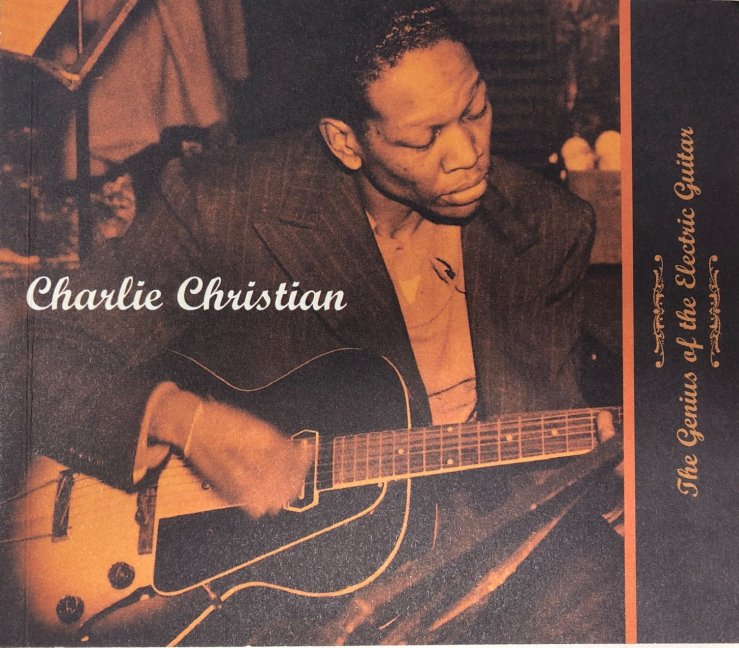
|
His Music
by
Loren Schoenberg
This collection gives as full a picture of Charlie Christian’s
musical persona as we will ever have. Context is everything in the
arts, and to hear him express himself coherently in the company of
stylists as diverse as Benny Goodman, Benny Carter, Jack Teagarden,
Lester Young, Cootie Williams, Dave Tough, Lionel Hampton and Jo
Jones is a revelation. His playing is startlingly different than
theirs, even different than Young’s, from whom Christian took the
basic fabric of his conception. You can hear the guitarist warming
up with paraphrases of classic Young solos during the rehearsal
segments, and we know from Goodman trumpeter Jimmy Maxwell that
Christian listened incessantly to Young’s recordings with the Basie
band on the band bus. But Young was redefining an instrument that
already had a distinguished heritage, while Christian was inventing
a new one. Yes, he learned from Eddie Durham and Django Reinhardt
and others who brought something new to the guitar, but in
Christian’s hands it became an altogether new instrument. With just
a few exceptions, he eschewed the chorded solos that were such a
large part of the guitar’s legacy. It was all about the line and
about how rhythm could extend the line and give it all sorts of new
and unexpected shapes.
October 2,
1939
Hearing these recordings in such superb
fidelity is like seeing a newly minted print of a classic film. All
sorts of details appear that were lost in the poorly copied
transfers that comprised the great majority of LP and CD issues
available until now. The depth of Artie Bernstein’s bass, with his
superb notes held for just the right duration; Nick Fatool’s wide
array of percussion sounds and dynamics; Hampton’s clean attack and
variety of articulations; Christian’s guitar, strong in solo and the
soul of discretion in accompaniment; Goodman’s rich, throaty tone
and use of all of the clarinet’s three distinct registers; the piano
melded into the middle of the rhythm section, yet audible when
involved in the trademark Goodman small group counterpoint – all of
these delights now emerge almost as though they were recorded just
yesterday.
Charlie Christian
sat in with Benny Goodman for the first time on August 16, 1939,
three days later was introduced to the nation on Goodman’s radio
show, the Camel Caravan, as a bright new star in the swing universe.
Goodman clearly wanted to let things jell before committing anything
to wax. He waited almost six weeks before taking the new Sextet into
the recording studio. Interestingly, the introduction to Christian’s
fir recording with the Goodman Sextet is played by Fletcher
Henderson. While no great shakes as a pianist (Ethel Waters chided
him as far back as the early ’20s for his “B.C.” style), Henderson
was a talent scout of the first rank. He hired both Louis Armstrong
and Lester Young as featured soloists in his big band before anyone
in New York knew who they were, and in the mid-’30s codified the
essential swing-style of big band arranging. "Flying Home," like
many of the other instrumentals that the Sextet played, does not
list Christian as the composer but is said to have been part of his
band’s repertoire before he joined Goodman. Virtually all the
bandleaders put their names on other people’s tunes – Hampton, in
his subsequent career as a leader being one of the worst in this
regard. The novel thing here is the timbre of the guitar, vibes and
clarinet and Christian’s resolute solo. He never hesitates for even
the slightest moment. Come to think of it, why should he have? It
was a tune he must have played many, many times before joining
Goodman. "Rose Room" was the tune Goodman called the first night
that Christian sat in with the Quintet. This version contains a
guitar solo that is so perfect phrase-to-phrase that it sounds
composed. Christian’s clean playing and his strongly defined rhythm
make the music coalesce into a kaleidoscopic series of angles as his
phrases shoot out over the rhythm section’s accompaniment. Rare was
the player who could so effortlessly pull off the triplets that
Christian plays towards the end of the first half of his solo. This
collection, with all of its multiple versions of the same piece,
shows the guitarist’s uncanny ability to invent seamless
improvisations. The perfection of his style makes us realize that
the seemingly disparate disciplines of improvisation and composition
merge in the work of great jazz musicians. Goodman himself never
sounded better than when had a superior melody to paraphrase, as he
does here and on the next piece. In fall 1939, Goodman went out of
his way to announce that the Sextet’s rendition of
"Stardust"
was built around Christian’s classic chorus, which he always played
verbatim – at least the live versions that survive. It is unusual
for him in that much of it is chortled. The voicings and general
shape reflect his admiration for his mentor Eddie Durham, who had
jammed with Christian in the mid-’30s and who had made classic
recordings on the electric guitar with Lester Young and the Kansas
City Six in 1938. Christian was also said to have played some of
Django Reinhardt’s solos by heart, and there may be a bit of that in
here too. Then there were the great Western Swing guitarists that
Christian undoubtedly heard. But regardless of its inspirations,
this solo (with its quote from "Pretty Baby") remains one of the
great "set" improvisations in jazz. It’s a pity it was never issued
during Christian’s lifetime.
November 22, 1939
The second session finds the Sextet
gradually developing its way towards its own identity. The solo work
is of course on the highest level, but the simultaneous interplay
that distinguished the earlier Trio and Quartets with Teddy Wilson
would only come with the presence of a superior pianist and more
time spent together. Nonetheless, the material is first-rate.
Goodman had been fooling around with different small group
interpretations of "Memories of You" throughout 1939, but it was
this first recording that cemented it as a cornerstone of his
repertoire. The piece had special resonance for Hampton, who had
made his first recording on the vibes on Louis Armstrong’s 1930
version. Coincidentally, Armstrong sat in with the Sextet just five
weeks earlier, on Goodman’s Camel Caravan show. This is our
introduction to Christian’s single-note ballad style, and if it
sounds powerful now, imagine what it must have sounded like in 1939.
There are none of the surface reflections of introspection that come
with the territory of ballads, no softening of the edge of the tone.
It’s not difficult to imagine how this approach might have affected
the young Thelonious Monk. The pianist said many years later that
the reason he never used a guitar in his band was that no one could
equal Charlie Christian, with whom he spent a short but intense
period jamming in Harlem. With "Soft Winds" we get the group’s first
movement towards alternation of forms. The Goodman Trio and Quartet
had recorded a handful of pieces that switched the form around, and
here the head is 16 bars long, but the solos are played over the
standard 12-bar blues format. The issued version has an
accompanimental figure that Goodman seems to cue too early on the
alternate. Note when the clarinet and piano veer toward
boogie-woogie in the background to Hampton’s solo – this would
blossom several months later into "Boy Meets Goy." There is
something about the melody and the way the guitar is integrated into
the arrangement that really sounds like Christian may have written,
although Henderson’s name is on it. Christian makes his first
appearance as co-composer on one of his own tunes on "Seven Come
Eleven." Odd that this would be the only title from the session
without an alternate take, especially since there is a wrong bass
note in the introduction. But Goodman, for all of his reputation as
a perfectionist, had already approved the release of with minor
imperfections if the spirit was there, as it is so clearly here. In
fact, you can even hear Goodman’s voice at the end of the track
singing back the closing riff, which was played with something less
than the group’s usual level of precision. The riffs behind the A
sections of the guitar solo make for an effective contrast with the
bridge, where the rhythm section plays standard time. Drummer Nick
Fatool is rarely remembered these days, but he was a superlative
percussionist who played with great taste and restraint. His
crackling rim shots and pushing hi-hats behind Goodman’s solo are an
indelible element of the performance.
December 20, 1939
Fatool’s backbeats are also a feature of "Shivers," a variation on
"I Never Knew," which introduces pianist Johnny Guarnieri to the
Sextet. Guarnieri is most often cited as a first rate mimic, and you
can certainly hear traces of Teddy Wilson, Fats Waller and Basie.
What is less remarked upon is his prescient ability as an
accompanist. He listens and he knows when to lead, when to follow,
and when to tread lightly between the two. From this point on, the
group begins to develop its own identity as an ensemble. Christian
came from the poor section of Oklahoma City, where one of his
boyhood chums was Ralph Ellison, who wrote: "Jazz was regarded by
most of the respectable Negroes of the town as a backward, low-class
form of expression, and there was a marked difference between those
who accepted and lived close to their folk experience and those
whose status strivings led them to reject and deny it." There is
something in Christian’s twanging chords throughout "Shivers" that
evokes his roots in the Southwest and is proof of his devotion to
incorporating that rare combination of the urban and the rural that
also marked the work of Charlie Parker. "AC/DC Current" is a blues
that lets the soloists play a four-bar break, and everyone has fun
with this. There are some broadcast versions of this piece where
things range pretty far afield; here they play it closer to the
vest. Another Hampton-Armstrong connection occurs with "I’m
Confessin’" which was among the tunes done at Hampton’s first
recording session as drummer in Armstrong’s band in 1930. While this
is certainly a distinguished reading, it lacks the singularity of
conception that marks the Sextet’s best efforts, which is probably
why it was originally withheld from release.
February 7, 1940
It was just a matter of time until Count
Basie appeared on a Goodman recording. His band had been rescued out
of obscurity by Goodman and Hammond in 1936, and within a year,
Goodman was playing Basie records for his own band, and asking why
they couldn’t sound like that. Basie sat in for a tune at Goodman’s
1938 Carnegie Hall concert, and you can hear Benny listening to
Basie’s accompaniment to his solo, eventually merging on a
characteristically Basie phrase at its end. The next month Goodman
recorded his own version of Basie’s theme song, "One O’Clock Jump."
Basie was a natural fit for this Sextet, since so much of
Christian’s style was based on the work of Basie’s featured soloist
Lester Young. This session happened at the tail end of a long day in
the studio for Christian and Goodman – the Metronome All Star
Session, three titles done with the Goodman big band (with the
guitarist sitting it out in favor of the band’s regular rhythm man
Arnold Covey) followed by this. "Till Tom Special" has more than a
touch of the Basie band’s hit "Topsy" in it. And it also resembles a
big band performance in the way that all of the soloists are wedded
to the text at hand. No gratuitous spitting back of chord changes
here – all of the solos relate directly to the tune. Listen for how
the soloists play off the backgrounds behind them. The sense of
wide-open space when Christian enters, with no organized backing,
just Basie’s intuitive comping, is the centerpiece of the
performance. The Sextet then creates another classic, "Gone With
What Wind," with opposite means. Here there are hardly any
backgrounds, just a string of superb blues solos wedded by Basie’s
sparse accompaniment. Once again, the issued take finds the sparks
flying and the unity of the clarinet, vibes and guitar on the
outgoing riff choruses is something to marvel at.
April 3,
1940
As one who has known these recordings for
over 30 years and who has heard them in all formats from 78 on down,
I can honestly say that I have never heard the pitches of Nick
Fatool’s tom-toms on the introduction to "The Sheik" sound remotely
this true to life. The added dimension in Goodman’s tone and the
blend of the rhythm section reveal detail that gives the music a
vibrancy it hasn’t had in previous incarnations. The subtle but
thrilling interplay between the clarinet, vibraphone and piano on
the second take of "The Sheik"’s first chorus gives a much clearer
picture of what this band was up to. Listen to Goodman and Guarnieri
interact, especially around the beginning of the second eight bars,
and then the way Goodman ties all of the ideas up at the end of the
chorus. This is chamber jazz at its best. The abstract way in which
the soloists ingeniously skirt the more obvious turns of the harmony
may surprise those who classify this as nostalgia or swing music or
anything less than vitally swinging and exploratory jazz. There are
moments, where Hampton and Christian veer off into harmony that is
far from the original, only to be brought back home by a "reminding"
chord from Guarnieri. In concept, it is analogous to the way that
the Miles Davis Quintet of the mid-60’s took liberties with the
standards they played. We also get a glimpse at Goodman’s sense of
humor. On the first take, Hampton launches his solo with a trademark
phrase that involves a dissonance followed by a rest and then
another note. On the second take, Goodman plays the dissonance with
Hampton and then fills in the space after the next note with a
perfectly timed note of his own. It’s a moment worthy in its comic
timing of Laurel and Hardy or Thelonious Monk and Art Blakey. Also
notable is the last chorus where the soloists trade four-bar
phrases. Listen for the humor in the second take, and how everything
leads naturally into the jam out. That’s what you get when you have
artists who collaborate for long periods and who have the
imagination to keep things fresh.
Frankly, the newly discovered
"Untitled Tune" is a bit of a letdown. Compared to the Sextet’s
other original material, it is determinedly mediocre. The form is
challenging, with alternations of 32-bar and 12-bar forms and
modulations (in fact you can hear the band crack up when someone
drops the ball on the breakdown take heard on Disc 4 track 8) but it
just doesn’t hang together, and one can certainly understand why it
was never released. What it does bring us are some more solos and
for that we should be thankful.
"Poor Butterfly" has an inspired
Christian solo that highlights the archly non-sentimental nature of
his ballad work. There is a Bach-like purity to his lines that
appealed to both Thelonious Monk and Lennie Tristano. Guarnieri
creates a subtle, Teddy Wilson-inspired counterpoint during the
first chorus, and works his way into his own Bach-styled phrase at
the conclusion of his solo.
April 10, 1940
"I Surrender Dear" comes with a couple of
breakdown/rehearsals (Disc 4, tracks 10 and 11) that include
bickering between future brothers-in-law producer John Hammond and
Goodman and a Hampton bridge that concludes with some harmonic
sleight-of-hand worthy of Art Tatum. The vibraphonist was an
incessant explorer of harmony, and has yet to receive his due as the
innovator he was. Hampton benefited greatly from the company he kept
during his Goodman years. Although a performance such as this may
seem like a informal jam, the arranged last eight bars and the
careful ensemble playing during first chorus give it the arc of a
composition. Besides contributing solos with some great whole-tone
moments, Christian’s quiet guitar strums at the very end are a
pleasant surprise.
"Boy Meets Goy" (later retitled
"Grand Slam" and "Boy Meets Girl") may have celebrated budding
relationship between Goodman and John Hammond’s sister Alice. It is
a blues with a lot of tasteful boogie-woogie – Guarnieri really knew
how to pile it on without be overbearing – a little boogie goes a
long way! – and a stunning climax. The newly discovered alternate,
which is fine as far as it goes – a brilliant set of solos – reveals
just how much performances can vary within a short amount of time.
The issued version is inexorable in gradual build and the elision of
one solo into the next.
June 11,
1940
"Six Appeal (My Daddy Rocks Me)" boasts
three newly discovered alternates, each of which have superlative
solos. Played largely over an expansive, two-beat foundation
supplied by Bernstein and Fatool, the solos deal with the tune’s
basis in a minor sixth chord in a leisurely and varied fashion.
Small details led to the selection of the issued take (the last
chain of breaks needed to be sorted out) but to hear the way the
group’s ideas coalesce is a wonder. Christian has most of his solo
worked out, and as we know from other examples in this set, he was
adept at spinning out fresh variations take after take if ne wanted
to. The piece has such a strong character that the solos are more
series of paraphrases than free invention, though it must be noted
that we hear many ideas from Goodman that are unique to this
session. This is one of the key elements that made the Goodman small
groups so interesting to listen to. It was not just a matter of
start and blow – pieces have their own character which the musicians
went out of their way to the investigate, thereby staving off
their boredom and ours. We also get a rare glimpse behind the scenes
in one of the previously unissued breakdown takes (Disc 4, track
13). You can hear from the strain in Goodman’s voice that this was
clearly not the first time he asked (seemingly in vain) for
Christian to turn down his amplifier. Far from being detritus or
harmful to the reputation of the participants, these illuminating
fragments make these men all the more human in light of their great
artistry.
"These Foolish Things" boasts a
quintessential Goodman reading of a superior song. Pianist Dudley
Brooks doesn’t get any solo space on this date, but does get in some
lovely fills on this piece. There is momentary confusion in the
rhythm section at the end of Hampton’s solo – they snipped eight
bars of the form to make things fit without having to raise the
tempo. Nonetheless Goodman chose to issue this take as opposed to
the beautiful alternate, with its more intimate introduction and a
closing bridge by the leader, which is a gem.
"Good Enough to Keep" makes for
an effective contrast. Here the soloists veer right off into their
own territory, unrestricted by any thematic reins. The alternates
find Goodman far less formulaic than on the issued one. The sense of
discovery in his solos is palpable as he invents intervals and
shapes that sound fresh today. The leader was not the only inspired
form that day – a torrent of swinging ideas flow from Hampton and
Christian, both flirting with aspects of the mixolydian mode. On the
first alternate listen for the of one of the vibraphonist’s pet
licks that was the centerpiece of his "Sheik Of Araby" solo. This
was the last a record date Hampton made as a member of the Goodman
band, and it stands as a testament to his unbeatable, unstoppable
brilliance.
October 28,
1940
Rumors were rife in the fall of 1940 about
the bandleading difficulties that both Goodman and Basie were
having. Goodman, coming off of back surgery, was in the process of
putting a new band together and Basie was having an increasingly
fractious time with his booking agency. There were even rumors of
the two bands merging, though in reality it never could have
happened. Their musical identities were already so unique and
divergent that neither party would have been satisfied. But one
offshoot of this brief period of change was a studio session at
which Goodman and Christian sat in with the Basie Kansas City Six.
It would be difficult to find adjectives to over-praise the results.
The sound quality is superb, each of the participants was in top
form and the band sounds as though they had been playing together as
a unit for years.
The most intimate music comes
during the one tune where Goodman sits out. It is truly an "Ad-Lib
Blues," growing out of a series of four bar breaks that initiates
each chorus. Of particular beauty are Young’s pair, which weave
varying patterns of diminished chords out of and right back into the
blues. The entire band seems to be thinking the music more than
playing it. There is no effort, just the eternal current of time
emanating from the Walter Page-led rhythm section, and carrying the
horns along with it. An abundance of phrases unique to this session
emerge from Young’s horn shedding new light on his early style,
which became the basis for entire movements within the jazz world.
Except when he is soloing, Christian doubles up on the rhythm with
acoustic guitarist Greene, and they never clash. As was his wont,
Christian shows absolutely no hesitation in his improvisations.
Sometimes it sounds as if he just threw a switch on and brilliance
came pouring out. Buck Clayton was that rarity, a trumpeter who
based his style on understatement, and who cultivated a sensitive,
almost frail quality. He could also do a fine Louis on open horn,
but his preferred method of expression was a sotto voce one, abetted
by his famous cup mute. After a string of solos, we hear Kansas City
jazz at its flowing best. Listen how Lester and Christian set spare
yet evocative riffs that let the rhythm section surround them,
breathing the beat. They have become a metaphysical one with the
quarter notes. This is a deceptively simple sounding art, somewhat
like haiku. One false move you’re sunk. These men knew how to do it.
About that we’re sure.
Goodman joins the band and the
ante is raised even further. He regarded few of contemporaries as
his artistic peers, but Young was clearly an exception. And Young
himself went out of his way to find records with Goodman on them in
the early ’31 when it became clear that no one was making that sort
of music on the clarinet. They only made a few sessions together – a
Teddy Wilson date with Billie Holiday, the jam session at Goodman’s
Carnegie Hall concert and an ad hoc WNEW broadcast with Roy Eldridge
and Wilson – and each is worth celebrating. This one is far superior
in fidelity. Add to this the musical relationships between Basie and
Young and Young and Christian and the stage is set for a truly
auspicious occasion, which is realized, and then some.
The two "Dream’s" are the same
piece, cut out of the same cloth as Lester’s tune "Conversation
Piece," which the KC Six had recorded the previous year as "Dickie’s
Dream." They are in a minor key with a sudden burst of major
tonality at the bridge. All of the soloists play with a Zen-like
intensity that makes it sound as though t instruments are playing
themselves. There are none of the outward manifestations of physical
effort that often mars lesser efforts. It is as though they are
thinking rather than playing the music. Young is so at once there
and not there that it begs the question that Sonny Rollins has posed
– which planet did Lester Young come from? Listen for the shouts,
cries, moans and bubbling laughter he gets out of his tenor
saxophone.
"Wholly Cats" is a blues that Jo
Jones credited to Lester Young. What more to say than here are some
of the music’s greatest individuals expressing themselves with great
clarity and concision?
"I Never Knew" was a favorite
tune of the Basieites, who, by the aural evidence delighted in
finding new ways around it rather limited harmonic scheme. This
version has a particularly perfect Young chorus, with an unusually
straight reading (for him) of the bridge’s chords. The rhythm
section shifts gears for each soloist without calling attention to
itself – this has become a virtually lost art. We also hear
Goodman’s penchant for incessantly setting riffs, most of which help
rather than hinder, but if you listen closely to Clayton’s bridge,
you will hear what may be Young clearing his throat in an attempt to
get Goodman to lay out for eight bars. One gets the impression that
Goodman was keeping Christian on a relatively short leash on this
session, which is too bad. It would have been great to hear him and
Lester stretch out a bit. But that is like complaining that a Chopin
Mazurka is only 3 minutes long.
As wonderful as this music was
and is, it wouldn’t do for Goodman. Too much was left to chance.
Goodman liked musical details nailed down. This was Basie’s world –
Benny was just living in it.
November 7, 1940
This is the first appearance of the new
band, which was known as ’’Benny Goodman and His Sextet," with Basie
sitting in again. Their first opus was reprised from the previous
session with the Kansas City Six. "Wholly Cats" goes through quite
an evolution over the course of five takes. The first has the melody
played in a very staccato manner, which by the next attempt has been
transformed into a legato, flowing line. Trumpeter Cootie Williams
had spent 11 years in the Ellington and knew how to weave his solos
out of a piece’s core, so that each creation had a tangible
relationship to the song that spawned it. Tenor saxophonist Georgie
Auld was a decidedly "macho" player who nonetheless had a tender
streak on ballads. They achieved a wonderful balance and really
listened to each other. Goodman loved a good challenge, and placed
himself after Christian in the solo order here and is clearly
inspired. Note how naturally his solo on takes four and five bridge
from the first chorus into the second. I don’t think Benny was ever
happier than he was at moments like this.
"Royal Garden Blues" was already
a relic when this version was made. The level of unity this septet
achieved on its first recording session is truly amazing. Williams
and Basie were past masters as ensemble players, and pulled out all
the stops here. Listen for how they modulate between their ensemble
and solo roles. They create what are by today’s standards miniature
solos that are worlds unto themselves. A note here, an inflection
there, take on great meaning in this context. All three versions
have the same unity and focus, yet build to Goodman’s climactic
choruses in slightly different ways. The original issue – the third
– is notable for Basie’s playing over the chorus between Williams’
and Goodman’s solos and the exquisite dynamic gradations the band
achieves. The arrangement is clever yet simple, and Christian’s
solos glide resolutely out of the traditional four-bar breaks.
"As Long As I Live" is
interpreted as a ballad, yet if you tap your foot along with it, the
tempo is actually a determined medium. Players of this magnitude can
do wonders with jazz rhythm and phrasing, and all of them play with
such relaxation that one gets the impression that the tempo is much
slower than it actually is. The Columbia engineers were quite active
on this session, mixing the band’s levels frequently, but doing it
in combination with the player’s artistry so that the effect is
almost transparent. Note the relationship between the piano and the
clarinet – indeed the way the whole band goes in and out of the
foreground – to sample what superior recording techniques can
create. Goodman’s bubbling trill underneath the piano sets the mood
for this treasure of melodic jazz. The first take has some figures
and an arranged ending that are jettisoned for the second, issued
one. They also goosed the tempo just a bit, and that magic that we
have sampled again and again in the Goodman small groups kicked in.
Williams’ solo loses the edge to the tone and takes on an
otherworldly feeling. There is an Apollonian reserve to this
performance that is reminiscent of some of the 1938 Goodman Quartet
recordings with Wilson, Hampton and Tough.
It is a pleasant surprise to
hear Goodman lead the rehearsal of "Benny’s Bugle" (Disc 4, tracks
21-22). So many bandleaders put their names on compositions they had
no hand in writing that it is comes as almost a shock to discover
that some of them actually did compose. Goodman takes the band
through the arranged segments, and although he has trouble verbally
articulating some of his more technical requests, all he has to do
is pick up the clarinet and play what he is hearing. We hear yet
another example of producer John Hammond being treated rather rudely
by Goodman, who suddenly drops the insults when he needs help with
the timing of the recording. But the irony of ironies is reserved
for a rare and possibly unique example of Christian’s voice. It
comes when Goodman, foreshadowing decades worth of aggrieved
bandleaders, asks the guitarist (and, it must be said, in a gentle
and patient manner) to turn down the amplifier. Lester Young once
put it aptly as "Down with the Edison!" and Goodman treats it as
something that will help Christian express himself more easily. This
is when we hear the guitarist’s low voice mumble something about
pickin’ and then possibly feign confusion about when Goodman wants
it turned down – the sum total of which is that there is little
variation in the amplifier’s volume. We know from one of the earlier
sessions that this was not the first time they had had this
conversation, which may help explain Goodman’s eventual exasperation
here. Count Basie is the perfect sideman, following Goodman’s wishes
to a tee and providing spare but vital inspiration to both the
ensemble and the soloists. The issued take, with its series of
perfectly formed and executed solos followed by Goodman wailing over
the band, would look good sculpted in marble.
December 19, 1940
As has already been mentioned, solos from
this session were spliced into composite takes back in the ’50s,
creating havoc for discographers, and robbing the solos of their
original context. With this collection, many of these sessions are
being issued for the first time both in their entirety and correct
sequence. Listen to the way the five versions of "Breakfast Feud"
(plus a couple of breakdown takes) flow into one another. On the
first, Williams is playing open horn, and pianist Ken Kersey backs
Goodman in the old oom-pah two-handed style. On the second, the
trumpeter switches to his famous plunger mute and begins sharpening
his conception. Kersey changes to a more sparse and flowing
accompaniment that forms a challenging background for the soloists.
Goodman always had an ear for what the piano was playing behind him.
One of the great joys of his earlier work was the spontaneous
counterpoint he would weave with Jess Stacy and Teddy Wilson.
Indeed, one of the most significant things about the bounty of new
material from this session is the glimpse it affords us of the young
Kersey. He played with the trumpeters Frankie Newton and Red Allen,
and was a regular in the jam sessions at Minton’s and Monroe’s and
can be heard jamming on a rare live recording with Dizzy Gillespie
there just months after this session. Kersey belongs right in there
with Clyde Hart, Nat Cole, Nat Jaffe and Thelonious Monk as a key
player who had new things to say before Bud Powell came along. His
solos here are full of spiky runs and intervals that probably goosed
Goodman, who always thrived on the challenge provided by an
exceptional player. We can also hear the rhythm section coalesce
take to take, and by the last few, they are really hitting it. The
second take has a particularly inspired Christian solo, long lines
are cast with a strong sense of urgency. The third find Goodman
bridging his choruses with a risky, chromatic idea that was not the
norm for him, at least as recorded performances tell us. And if that
were not enough, Goodman charges into his solo on the fourth take a
few beats early, using the anticipatory motif throughout both
choruses.
"I Can’t Give You Anything But
Love" is one of the great Goodman small group recordings of all
time. Everyone is in superlative shape, especially Auld who, to the
ears at least, never sounded better on any recording. The first take
finds Christian a his most rhythmically relaxed; on the bridge he
throws in a rhapsodic phrase that is remarkably Reinhardt-esque. The
second may have the best of the Auld solos, while the slightly
faster third finally gets a good level on the piano, which is why it
was probably selected for issue.
"Gilly" is in reality
"Gone With
What Draft." Unissued at the time, this version was renamed for
Goodman’s stepdaughter on the occasion of an early ’50s LP issue. It
is a complicated piece, with many different riffs, backgrounds and
dynamics, and it sounds as though the band is just easing into it.
This is the kind composition that has all of Christian’s hallmarks.
His guitar changes sound and effects every time it reenters, and
underscores Christian’s talents as an ensemble musician. As good as
these versions are (and there are outstanding solos) it got a better
interpretation on the following session.
January
15, 1941
The next session is a red letter one in
the careers of both Basie and his drummer Jo Jones. We get an
extraordinarily clear picture of their strengths from hearing them
divorced from their usual context and placed in the middle of the
Goodman septet. Their attention to the minute details is a
revelation. Listen across the four takes of "Breakfast Feud" where
they examine almost every ensemble phrase to see which sort of
accent, if any, it should receive. Both were able to play with the
lightest touch without losing any of their intensity. Jones created
similar miracles that are all his own on Goodman’s 1954 "Get Happy."
And the perfectly natural recording balance makes it all the easier
to hear precisely what they are doing. The clarinet solos are also
worthy of singling out. Here we have Goodman with a clear concept –
the low register, or chalumeau solo that his early mentors, the New
Orleans clarinetists Jimmy Noone and Johnny Dodds were masters of.
He works his way down the horn during his first choruses before
really giving its bottom half a workout in the second. Goodman takes
advantage of Basie’s plunging bass lines – he was a great listener
and reactor, and strikes gold on take three – the variety of phrases
and shapes Goodman improvises is astonishing. Basie sets to work on
his own two-chorus gems, playing off of the horn’s sotto voce
background of phrases that are once eminently pianistic and
Armstrong-esque. As we have seen, multiple takes were the norm on
these Goodman small group sessions. There must have complete
unanimity of feeling about "On the Alamo" for it to survive with no
backup. Goodman had worked with the man who wrote, bandleader Isham
Jones, and mines every bit of beauty out of its sequential melody.
Has any trumpeter ever had a more dense and majestic lower register
tone than Cootie Williams? Before he became the plunger soloist par
excellence in the Ellington band, Williams was known as a
superlative lead trumpeter, and his open horn work remains a rare
and wonderful treat. Photographs from these sessions reveal a
paucity of microphones, but the balance the engineers achieved
(which let the musicians determine their relative volume) remains
unsurpassed well over half a century later. What a joy to hear each
instrument in the rhythm section so clearly, and to get this rare
glimpse of Basie the ensemble pianist away from his usual milieu.
Auld’s tone is golden, as are his phrases. While he seems to have
both Ben Webster and Lester Young on his mind at times, he arrived
at his own stylistic mixture (and influenced others, including Flip
Phillips, who knew these recordings intimately), and is a wonderful
ensemble player to boot. Goodman chose to issue the slower of the
two takes of "I Found a New Baby," but the faster alternate was the
one known to people since it was issued as part of Columbia’s 2-LP
Solo Flight compilation in the early ’70s. Christian’s solo from
that take became the basis for Phillip’s tune Christian Scientist,
which he recorded with the guitarist Howard Alden in the late ’80s.
Williams makes an amazing variety of sounds with his plunger mute
(hear the way he begins and how he gradually opens it up), modifying
his melodic conception as he manipulates the tone. The tight
structure of "Gone With What Draft," with all of its shifting
sections, gives drummer Jones ample opportunity to display his
orchestrational abilities. Each take finds him making new and
surprising choices, and he was not the only one sparked to new
heights. The leader himself finds some new ways around these
well-worn "Honeysuckle Rose" chord changes on the original issue
(take three), especially as he gets into his last eight bars.
March 13,
1941
We begin with the band (without Goodman
and bassist Bernstein) warming up in the studio prior to the
beginning of the recording session. This is found on track 23 of
disc 4. The musicians simultaneously create a tableau that is
discursive at times and riveting at others. Tunes come and go at the
slightest suggestion, with no squabbling about keys, format or
tempo. We learn so much about Christian’s musicality from these
rehearsal sessions. All of these musicians were masters of
sequential improvisation, where one phrase is varied from chord to
chord. You can hear all of them do it, and Williams and Christian
have no problem maintaining their spontaneity and sense of discovery
while fulfilling the form’s rather strict guidelines. Wonders
abound. Williams plays a chorus using his ex-Ellington band mate Rex
Stewart’s patented half-valve fingerings, and then offers a personal
tour through some of his favorite Armstrongisms, many of which sound
remarkably like what cornetist Ruby Braff came up with years later.
There is a poignant moment during "I Can’t Believe" when Williams
free-associates into "After You’ve Gone" – reminding us that this
was indeed Christian’s last recording session with the Goodman
Sextet. This coincidence is further compounded by the jam on "Rose
Room," which was the first tune Christian ever played with Goodman
just a mere 19 months earlier. There is another spot where Christian
takes a phrase and varies it through the chord changes, eventually
carrying Auld and Guarnieri along with him. In this informal way,
players exchange information and equipment for improvising. It’s one
thing to know they did it, and another to actually hear what it
sounded like. We also hear some of Christian’s non-four-to-the bar
comping techniques peppered throughout.
Dave Tough goes through the
various components of his drum set, from snare drum to brushes to
sticks to various cymbals and through all of it, gets his right foot
acclimated to the bass drum, which was at the root of his magic. All
of this makes the sparseness of what Tough plays on the date itself
all the more astonishing. There are the odd snare accents and
sudden cymbal crashes, but he spends the overwhelming majority of
his time padding on the snare drum with his brushes (which Benny
referred to dismissively as the flyswatters). What we are hearing is
a profound distillation of jazz rhythm married to what Artie Shaw
has called Tough’s great psychic energy. Indeed, both "A Smooth One"
and "Air Mail Special" represent a minimalism that remains quite
rare in jazz. Yet within each performance we find a tremendous
variety of sounds and approaches, albeit within a subtle range: on
the former, the new, evocative sound of the trumpet, clarinet and
electric guitar in unison behind the tenor solo; Christian’s last
bridge, which is played almost verbatim on all three takes and
henceforth becomes part of the tune; Guarnieri’s subtle but fully
orchestrational playing throughout; the way Tough play cat and mouse
with Williams’ high trumpet flicks in the last chorus. "Air Mail
Special" has its own share of delights: the dying sound of Goodman’s
high clarinet notes behind Christian’s solo; the way all of horns
and piano go in and out of the foreground, with the many riffs and
backgrounds never getting in the way; the expert use of dynamics;
Guarnieri’s low ringing notes during the first chorus; the unusual
logic in Goodman’s last eight bars.
February 7, 1940
November 22, 1939
June 25, 1940
March 4, 1941
One can only imagine that Christian must
have been at least somewhat amazed that only four months after he
had been playing in relative obscurity in Oklahoma City for peanuts,
he was now a featured soloist on a Metronome All-Star date, trading
choruses with Jack Teagarden, Benny Carter, Harry James and Gene
Krupa. "All Star Strut" is a fascinating document in that it lets us
hear Christian in a much wider context than that of the Goodman
band. There is something different about Christian’s chorus than the
others. He has his own vocabulary and time feeling. We also hear him
comping behind Haggart’s walking bass solo and on the breakdown take
he branches off from Benny Carter’s closing string of eight notes,
bringing us right into his own world. Another highlight is the way
James and Krupa clinch the transition into the last jam chorus on
the alternate take.
The big band items are a treat.
We hear three of the greatest Goodman arrangers. Fletcher
Henderson’s "Honeysuckle Rose" is a veritable feast of antiphony,
with nary a measure goes by without busy reed and/or brass figures.
Christian’s even phrase and occasionally staccato notes swing
immensely, and the logic of the solo is staggering. Trumpeter Ziggy
Elman and the leader are also inspired. "Li’l Boy Love," with its
nod to Prokofiev in the introduction, is a brilliant example of
Eddie Sauter’s startlingly original conception for the jazz
orchestra. Gone are the gratuitously repeated sections that were
endemic in the swing band genre. Equally arresting is the
never-ending variety of orchestrational fancies that Sauter
unleashes. Christian weighs in for the last bridge for a relatively
ordinary 8 bars. He is the featured soloist (save for a brief and
very hot salvo from the leader) on "Solo Flight," originally titled
"Chonk, Charlie, Chonk." Jimmy Mundy fashioned an effective showcase
of Christian’s tune, though even a few bars of wide-open space would
have been nice to offset the density of the writing. Part of the
problem is that the band is too loud in the mix. They are playing a
background to the guitar, but the Columbia engineers, in an
anomalous decision, made the full ensemble the aural equivalent of
the solo. The alternate finds Christian in a more voluble mood.
Drummer Dave Tough’s constant counterpoint is totally original and
in keeping with his ascetic approach of the Sextet session recorded
just 9 days later. Sadly, like "Stardust," this recording remained
unissued during Christian’s lifetime.
– Loren Schoenberg
May 2002
Loren Schoenberg played in
Benny Goodman’s band and is a conductor, saxophonist and teacher. He
is the Executive Director of the Jazz Museum in Harlem, and the
author of The NPR Curious Listener’s Guide to Jazz.
|