|
SOLO FLIGHT THE CHARLIE CHRISTIAN LEGACY |
|
|
|
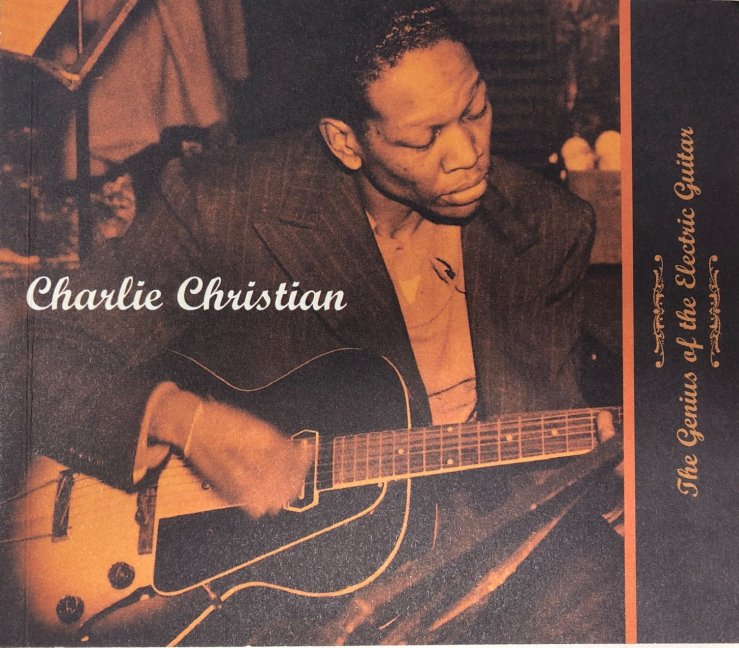
CHARLIE CHRISTIANHIS LIFE
|
|
His Life
He had been a patient at Seaview for almost eight months, receiving treatment for pulmonary tuberculosis, from which he had been expected to recover. The so-called ‘modern treatment’ that he received dated back to the 1890s and consisted of an abundant supply of fresh air, milk and nutritional food. With his death the world of jazz was to lose its foremost exponent of the electric guitar. Within the compass of his short stay with the Benny Goodman Sextet, Charlie had single-handedly elevated the guitar from the rhythm section to the status of a front line solo instrument. He had a profound influence on every jazz guitarist who followed him. Charlie Christian was one of a kind and we shall not see his like again.
Charles Henry Christian, the youngest of three boys, was born on July 29, 1916 in Bonham, Texas, located approximately 65 miles North East of Dallas lying close to the Texas/Oklahoma border. Charlie came into the world on a hot afternoon at the family home on 511 West Johnson Street. Charlie’s parents, Clarence James and Willie Mae played trumpet and piano respectively in a silent movie theater in Bonham. Edward (Eddie Christian, ten years Charlie’s senior, was to become a well-known pianist in and around Oklahoma where he gigged with his own orchestra and small groups until his death in October 1948. Tragedy struck the Christian family in 1918 when Clarence Sr. lost his sight as a result of illness. He began playing guitar on the street to earn a little money, possibly accompanied by Edward on mandolin and middle son Clarence Jr. on violin. He’d taught all three sons to play stringed instruments at a very early age. The loss of steady income forced the family to leave Bonham and travel to Oklahoma City, presumably because Willie Mae’s mother had set up a small but successful business there. In 1923 Charlie attended school for the first time, at Page Elementary School. Word has it that Charlie was not keen on school and tended to hang around the school rather than actually attend classes. One story has him distracting students with his ukulele. In 1926, Clarence Sr. passed away after a long illness. Willie Mae’s maternal strength held the family together, and her boys were devoted to her for the rest of their lives. At this time, Charlie inherited his father’s two guitars, but continued playing ukulele, as he was not old enough to play the full sized instruments successfully. In 1928 Charlie attended Douglass High School where apparently his penchant for truancy remained. Charlie now turned to playing music on 2nd Street in Oklahoma City where he is known to have performed on a regular basis as early as 1926. While at Douglass, Charlie did play baseball and, according to some, bass with the school band. Bluesman T-Bone Walker, also an early pioneer of the electric guitar, has claimed that he first met Charlie ‘on the street’ in Oklahoma City around 1929. . In 1930, Charlie met Margretta Lorraine Christian (no relation) from Pittsburgh, Texas at a school baseball game; their relationship flowered and on December 23, 1932, Margretta gave birth to their child Billie Jean. He had only recently quit school, never completing the 10th grade. 1932 was a musically significant year as well. One evening Charlie sat in on guitar with Edward’s band at Honey Murphy’s Club on 2nd Street. He played three tunes to great response and earned a regular spot in the band; he had turned pro. That same year, he also met and had repeated opportunities to jam with Lester Young, studying the saxophonist’s mellifluous, lyrical style first hand; Young would have a profound influence on Christian’s linear approach to improvising. Oklahoma City was a regular stop for all the important territory and national bands most of whom would play first at the principal white venues, then work a dance at Slaughter’s Hall on 2nd Street, or ‘Deep Deuce’ as it came to be known, in the black part of the city. Deep Deuce consisted of the 200 block of 2nd street, bounded on the East by N. Central Ave and on the West by N. Stiles Ave near the black-owned hotels where travelling musicians had to stay. This was truly the heart of black Oklahoma City where lawyers, dentists, tailors and pharmacists thrived by day and hustlers, pool sharks and bootleggers appeared amid the abundant nightlife. Street life included open-air dances on Thursday (“Maid’s Night Off”). Soft drink and barbecue stands dotted the main street. As one current day resident of Oklahoma City has recounted “We were poor, there were few jobs and little money for black people and so we had to make our own fun.” Even the discovery of oil in Oklahoma City in the late ‘20s generated no jobs for the black population. Despite segregation and the Great Depression, this remained a vibrant community. Charlie thrived at the jam sessions on Deep Deuce with visiting musicians; they’d often go on all night and into the next day. The young guitarist came into contact with some of the most famous musicians in the country there. T-Bone Walker returned to Oklahoma City in 1933 with the Dallas-based Lawson- Brooks Band. He and Charlie renewed their acquaintance, often playing together on the street where crowds would tend to gather on the warm evenings. T-Bone says that they had a bass and a guitar, which they would exchange during numbers as well as going into dance steps to amuse the crowd. Throughout 1934, Charlie continued to work with his own trio (with saxophone and drums) and his brother Edward. It has been reliably reported that with Edward’s band he’d often solo with a microphone held between his knees in order to be heard. During the 1936 Texas Centennial in Dallas, Milt Hinton saw Charlie playing a guitar with a ‘spider’ microphone attached to it with rubber bands. Charlie certainly acquired his first electric guitar, a Gibson ES-150 and amplifier, in 1937 and used it on all of his professional appearances. He also began travelling more that year, joining Omaha-based Anna Mae Winburn and her Cotton Club Orchestra. Anna Mae was, by all accounts, a very good-looking and well-liked singer. According to Christian, they toured mostly in Illinois and Minnesota. The length of Charlie’s tenure is unknown, but he was reportedly a frequent visitor to Omaha, often sitting in after hours at a particular saloon there. The band remained in business as late as August 1938. He was playing with the Alphonso Trent Sextet in Bismarck, North Dakota very shortly afterwards. Mary Osborne tells of hearing him there, playing electric guitar voiced with a trumpet and saxophone. She was so impressed that she bought an electric guitar the very next day from a music store in Bismarck that was advertising the Gibson ES150 guitar ‘as used by Charlie Christian.’ It’s likely that Christian first heard electric guitar from the jazz-influenced Western Swing steel guitar players like Bob Dunn (who recorded with one in January 1935), Leon McAuliffe (of Bob Wills & His Texas Playboys) and Muryel ‘Zeke’ Campbell. These musicians were frequently in Oklahoma City and heard daily on local radio. It is often thought that Eddie Durham was the first to record jazz on the electric guitar on the March 18, 1938 Kansas City Five session in New York. Actually a young George Barnes used it on a Big Bill Broonzy session in Chicago on March 1 and by July 7, he’d recorded with it on nine more occasions. Charlie reappeared in Oklahoma City in the spring of 1939 fronting his own small band and making $2.50 per night when most locals were making just over $1 per night. But his life would soon change. On March 16, 1939 in New York City, Andy Kirk’s band recorded “Floyd’s Guitar Blues,” which was arranged by the band’s pianist Mary Lou Williams and featured Floyd Smith on electric steel guitar. Later that day, Williams and Smith also appeared on a session by Mildred Bailey and her Oxford Greys, Mary Lou has recounted a conversation in the studio with producer John Hammond who had remarked about Floyd’s whining guitar sound, whereupon she told him that Charlie Christian was the best guitar player that she had heard. In early July, the Andy Kirk Orchestra came to Oklahoma City’s Ritz Ballroom. At an after hours jam session at Ruby’s Grill, Charlie easily cut Floyd Smith. Later that morning Mary Lou Williams asked Charlie, at Hammond’s request, if he would join the Benny Goodman Orchestra if the opportunity presented itself. At first Charlie was reticent and Mary Lou was given to understand that he had a number of offers from territory bands and wanted to stay in the area. Charlie finally agreed with the words “Mary, I’ll join if you will too.” Mary Lou wired Hammond in New York City. A few days later Charlie received a telegram from Hammond saying that he would like to audition the guitarist’s band in Oklahoma City on his way to Los Angeles to oversee a Goodman recording session in early August. Charlie agreed. Hammond was met at the airport by Charlie’s band loaded into a single car, taking Hammond to a hotel where Charlie’s mother was a chambermaid. Hammond was impressed by Charlie, but not his band. Later in the month Charlie received a telegram from Hammond asking him to come to Los Angeles to audition for Goodman and wiring him $300 for expenses. After a big send-off at Ruby’s Grill, Charlie left for Los Angeles on Monday, August 14. The Saturday August 19th issue of the Black Dispatch, the local black newspaper, carried a photograph of his departure on the front page. It shows Charlie dressed in comfortable open necked shirt and slacks for travelling. In his left hand is a chocolate-colored broad-brimmed hat; between his feet is his beloved Gibson ES150 guitar in its case. Charlie’s arrival in Los Angeles on Wednesday, August 16 is the subject of some myths. The story that Charlie arrived at the studio in time to spoil a take of “Spring Song” just isn’t so. Hammond later wrote that Christian wore gaudy, loud apparel, but his family claimed that he never wore such clothing and musicians at the session thought him dressed plainly but looked ‘somewhat countrified.’ Both myths are variations of the old cliché of the country bumpkin coming to the sophisticated big city. Hammond recounts the next part of the story saying that Benny Goodman did not want to audition Charlie at this time, finally agreeing but not allowing Charlie the time to plug in his amplifier. They played “Tea for Two” and an unimpressed Goodman left hurriedly. Charlie said that he was so nervous that ‘he could hardly play at all’ but that Goodman did invite him to come to the Victor Hugo that same evening. At the Victor Hugo that evening, Hammond and bassist Artie Bernstein sneaked Charlie onto the bandstand during the dinner break. Upon his return, Goodman was not pleased but made no objection and called “Rose Room.” Hammond wrote that the tune lasted 47 minutes and that Benny’s group never sounded better. Charlie was hired and became a nationwide star within a few short weeks. A Hollywood Bowl broadcast on August 19 featured him playing “Flying Home,” a tune that he had brought with him from Oklahoma City. Days later, the Goodman band flew to the East Coast for a week at the Steel Pier in Atlantic City, then on to Detroit and Toronto, returning to New York for the World’s Fair and a lengthy engagement at the Waldorf Astoria Hotel. Goodman featured the sextet with Christian on one tune during his weekly “Camel Caravan” network radio show. Family and friends in Oklahoma City were able to at least hear him every week. He was now earning a guaranteed $200 per week – a King’s ransom compared to what he had previously made. Goodman’s schedule was an exacting one, but travel conditions were considerably more comfortable than Charlie had experienced with territory bands. Christian continued to jam after hours, sitting in wherever he could. There is little doubt that he must have burned the candle at both ends. His friends and band colleagues say that he drank very little, but he loved to dance and had a decided liking for marijuana, which he generally smoked in the back of the band bus. He acquired a portable record player and would use it continually when travelling, his preference being for Lester Young whose solos he could sing at the drop of a hat. He also drove his fellow musicians to distraction with his singing of the old Dixieland warhorse “Shim-me-sha-wabble.” Charlie’s first official recording session on September 11, was an all-star affair led by bandmate Lionel Hampton for Victor. On October 2, 1939, the Benny Goodman Sextet with Christian and Hampton made its first recordings: “Flying Home,” “Rose Room” and “Stardust.” Four days later, when the Goodman band appeared at Carnegie Hall, the guitarist was featured on “Stardust.” On Christmas Eve with two more sextet sessions under his belt, Charlie was back at Carnegie Hall for the second Spirituals To Swing Concert where John Hammond, without Benny Goodman’s permission, asked Charlie to play with the Kansas City Six before his set with Goodman. Benny was furious with Hammond for having hijacked his star. In early January, Goodman gave the band a two-week holiday and Charlie returned to Oklahoma City and Ruby’s Grill. The Black Dispatch recorded his every move and Charlie in all his sartorial splendor was treated like royalty. On January 1st 1940, DownBeat announced that Charlie had won the DownBeat Poll for best guitarist after only four months in the national spotlight (the 78 of “Flying Home” and “Rose Room” had been released on November 2). Charlie went back to New York and the grind of one-nighters. On February 7, 1940, he recorded with the sextet again as well as the Metronome All Stars. When the orchestra arrived in Chicago two weeks later, Charlie was taken ill with a temperature of 104° and hospitalized. A routine X-ray revealed tuberculosis scars on his lungs and the doctors recommended a rest. Charlie ignored this warning, although Goodman’s back problems did give the band an extra two-week break. A two month stay at the Coconut Grove in Los Angeles starting March 19 gave Christian the opportunity to seek out the after-hours spots on Central Avenue where he could jam the night away with the best that Los Angeles had to offer. Goodman recorded the big band and the sextet there on April 3 and 10. After gigs in San Francisco and Catalina, they were back in Los Angeles where the sextet made another session on June 11. On July 10, Goodman’s sciatica had become so painful that he was forced to fly to the Mayo Clinic in Minnesota for an operation. During his recovery, which would last until mid October, only five indispensable sidemen were retained on salary; one of them was Christian. Charlie took the opportunity to return to his close-knit family in Oklahoma City. Except for occasional forays to Deep Deuce to jam with his friends and ‘sit in’ with bands that came into town during the months of August and September, he seems to have used this time to rest, which may have helped to improve his health. It was during this visit that a friend tipped him to Barney Kessel, still a high school student, who was playing at a local club. They spent three afternoons jamming together at the Civic Auditorium where Kessel’s high school band was giving nightly concerts. Charlie arrived back in New York City in early October, having driven from Oklahoma City, with a stopover in Kansas City, in his new Buick Dynaflash automobile. The reformed Goodman band began rehearsing on October 18. Benny gigged locally with a small group. It is clear that Goodman had a very high regard for Charlie’s ability and they went out together to sit in with other bands at this time. Goodman and Count Basie got together on October 28, 1940 for an informal session in the Columbia Studios. Charlie and five members of the Basie band including his hero, Lester Young, completed the group. This session was not publicly known about until the 1970s. Hammond’s first wife, Jenny, in clearing out their apartment following their divorce, sold a large collection of records to a second-hand dealer in Lower Manhattan. Among them was a set of acetates of this now famous session – the only recorded encounter of Christian and Young. In late October, Goodman announced that he had succeeded in hiring Duke Ellington’s star trumpet player Cootie Williams to join his orchestra and in particular be a feature attraction in the soon-to-be-formed septet, which was to be known as Benny Goodman and His Sextet. Cootie had actually taken this one-year contract (he stayed for two and substantial pay raise with Duke’s blessing, which was not generally known at the time. On November 7, this very different ‘sextet’ was in the studio. Lionel Hampton’s vibes were replaced by Cootie’s trumpet and George Auld’s tenor saxophone. This instrumentation (minus the clarinet) was identical to the group that Charlie had led in 1939 before leaving Oklahoma City. This personnel seems to have sparked Charlie’s playing, and he entered the most productive period of his stay with Benny Goodman. Fortunately, the complete acetates of the group’s first studio session have survived the passage of time and are included in full in this set. This will give listeners a clear insight into how the ‘sextet’ worked in the recording studio. On “Benny’s Bugle,” all of the studio chatter is preserved as well as three takes, two run-throughs and a number of rehearsals and breakdowns. The ‘sextet’ recorded again on December 16, 1940. “Breakfast Feud” is heard for the first time, a tune that would gain infamy for the 1955 LP issue of several takes spliced together. This consisted of a single take into which guitar solo choruses from other takes are inserted. Yet another spliced-together version was issued in 1972. At the time of release, it was not known how many takes were in existence or that takes from the sextet’s next session of January 15, 1941, which also contained “Breakfast Feud,” were also spliced in. Confusion reigned for a number of years as Goodman collectors tried to unravel the mystery, which was not cleared up until the 1990s. No spliced composites are contained in this set. Charlie topped the Downbeat Poll for best guitarist for the second time in 1940, again by a substantial margin over his nearest rival. On January 16, 1941 Charlie and Benny were part of the annual Metronome All Stars Session, this time for Victor. The Goodman band continued to work in and around New York City, occasionally venturing further afield. They appeared weekly on the “What’s New” radio show from February through April, and each program had at least one ‘sextet’ feature. Many Charlie Christian fans consider that his finest recording with Goodman was made on March 4, 1941. The tune, inappropriately named “Chonk, Charlie, Chonk” is yet another original that Charlie had brought with him from Oklahoma City where he had featured it regularly. Orchestrated by the arranger Jimmy Mundy, it was heard on the March 3 “What’s New” program and a May or June broadcast for Mutual. When “Solo Flight,” as it was aptly renamed, was finally released in December 1943, it soared straight to #1 in the Billboard Harlem Hit Parade and reached #20 in the Billboard Hot 100 (Pop) almost two years after Charlie’s untimely demise. A second take was released in 1955. Two photographs taken at this session have survived and Charlie is shown standing next to Goodman surrounded by other members of the band. Although Christian had on rare occasions taken solos with the orchestra prior to this recording, “Solo Flight” was a stunning feature built around the guitarist. The late great Jimmy Raney told this writer in the mid ‘70s: “Man, when I first heard it, I almost fainted!” The final recording session for this edition of the ‘sextet’ took place on March 13, 1941 when the second version (but first issued) of Charlie’s tune first known as “Good Enough to Keep” and later “Airmail Special” was recorded. This tune was also to become the subject of infamous splicing in ’55 and ’72, but with only two recorded takes, collectors had little trouble deciphering these composite issues. It is not known when Charlie first started to visit Minton’s Playhouse to jam after hours. Minton’s had first opened a number of years earlier at the Hotel Cecil at 220 West 118th Street in New York and was situated between 7th Avenue and St. Nicholas. Originally a mainstream jazz club, it changed policy when Henry Minton put ex-bandleader Teddy Hill in charge in October 1940. Hill hired drummer Kenny Clarke to take charge of the musical direction. Clarke brought in trumpeter Joe Guy, pianist Thelonious Monk and bassist Nick Fenton to join him as the house band. This was to prove one of the most influential decisions ever taken in the history of jazz, leading as it did to the formation of what came to be called bebop a few years later. From the outset, the new club was a big success; musicians had a place where they could play whatever music they wished without interference from the management. Hill instituted a Monday Celebrity Night which ensured that there was a regular supply of quality musicians to ‘sit in’ since bands were off on Mondays and musicians could spend the whole evening enjoying themselves, listening to and playing music of their choice with free food and drink. Charlie certainly came and was quickly co-opted into the house band; Teddy Hill bought an amplifier and guitar to keep at the club for him. Kenny Clarke told this writer that “Charlie came every night and stayed all night.” Shortly after Minton’s opened, there was a backlash by members of the band – probably led by Thelonious Monk – against ‘sitters in’ who were not up to standard. It was decided to play in difficult keys, change key in mid number, play at fast tempos – anything that would keep the lesser musicians off the stand, and it worked. Soon, the best were able to jam together to their hearts content. The recordings made by Jerry Newman in May 1941 glimpsed the change from swing to bop as it was happening. That June, the Goodman Orchestra was on the road again, but Charlie collapsed during a tour of the Midwest and was rushed back to New York where he was admitted to Bellevue Hospital. His condition was assessed as “fair, not dangerous.” On July 7, he was transferred to Seaview Hospital, a municipal sanatorium, on Staten Island. His tuberculosis had returned. Teddy Hill visited Charlie every Sunday, bringing with him a regular gift of food cooked for him by ‘Mom’ Frazier, whose 125th Street restaurant he had regularly patronized. Count Basie’s personal physician came on a weekly basis to ‘supplement the hospital’s care.’ With only a few friends able to visit him in Staten Island, this must have been a very lonely time for the affable, gregarious young man. The following January, Charlie was named best guitarist in the Downbeat Poll for the third straight year, garnering about 40% of the vote. In mid February, friends visited him with some marijuana and female company. The story goes that Charlie contracted pneumonia as a result and that this hastened his end. However his death certificate, issued on March 3, 1942, clearly states the cause of death as primarily chronic pulmonary tuberculosis. Charlie Christian had three funeral services. The first took place at Mother Zion Church on 137th Street in Harlem, from where Charlie’s body was flown back to Oklahoma City in a plain coffin. The second funeral service took place there on Monday, March 9th, preceded by a traditional New Orleans style funeral procession to the Calvary Baptist Church on Walnut and 2nd, where he lay in a lavish casket with a guitar-shaped wreath from local musician-friends and large floral display from Goodman. The Black Dispatch reported it as one of the largest funerals ever to take place in the city. The funeral cortege departed for Bonham, Texas where Charlie’s family and friends stayed with his relatives on both sides of the family. Following another service at the Bethlehem Baptist Church, Charlie was finally laid to rest in Gates Hill Cemetery on March 10, 1942.
Charlie Christian was undoubtedly one of the most important musicians of the 20th Century. His name is ranked alongside those of Louis Armstrong, Earl Hines, Lester Young and Charlie Parker; each elevated music to a new level of achievement, whilst establishing a new vocabulary that made them the premier voice on their chosen instrument.
|
The
late Peter Broadbent was the owner/administrator of The Charlie Christian
Archive,
a large reference collection of material specific to Charlie Christian.
Peter’s latest biography on Charlie Christian was published in 2003
by Ashley Mark, Newcastle upon Tyne, England.
[ Discography Index ] [ Tune Title Index ]
|