|
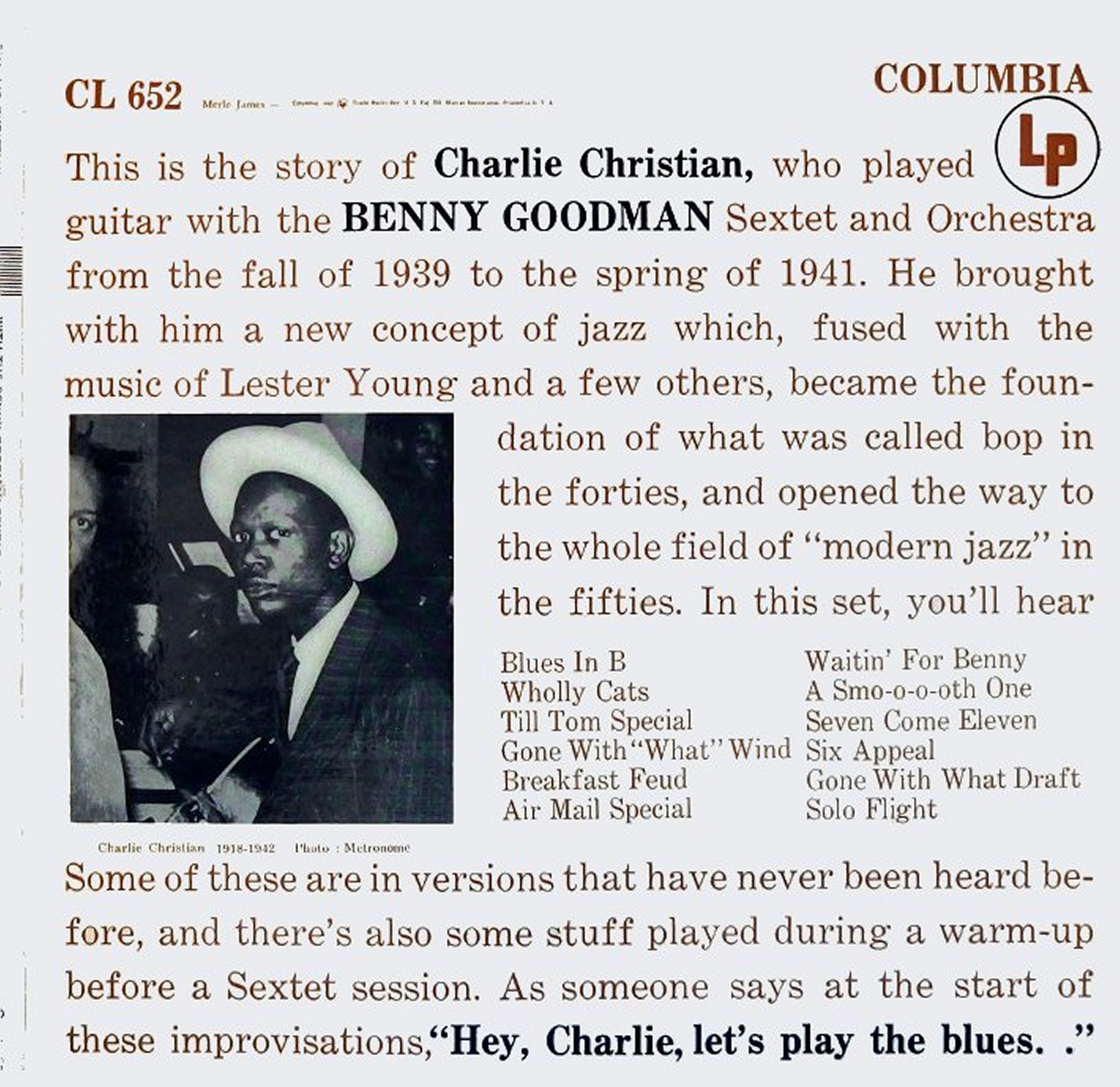
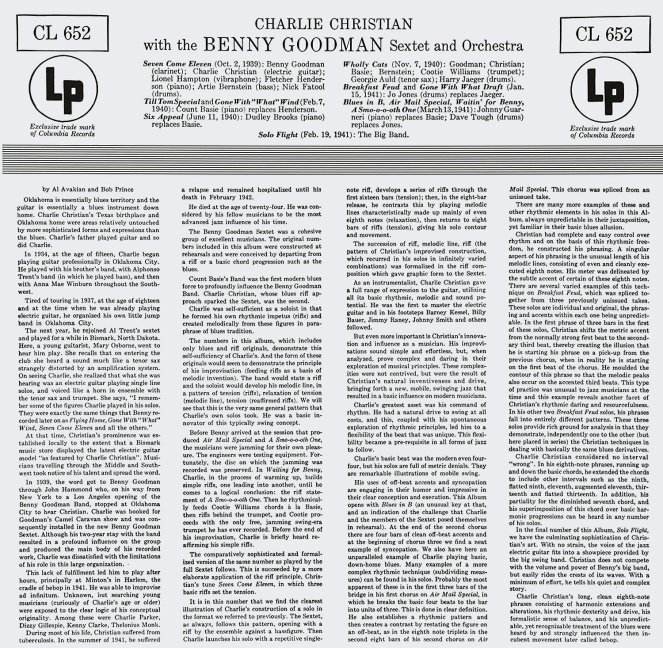
Oklahoma is essentially blues territory and the guitar is essentially a blues instrument down home. Charlie Christian’s Texas birthplace and Oklahoma home were areas relatively untouched by more sophisticated forms and expressions than the blues. Charlie’s father played guitar and so In 1934, at the age of fifteen, Charlie began playing guitar professionally in Oklahoma City. He played with his brother’s band, with Alphonso Trent’s band (in which he played bass), and then with Anna Mae Winburn throughout the Southwest. Tired of touring in 1937, at the age of eighteen and at the time when he was already playing electric guitar, he organized his own little jump band in Oklahoma City. The next year, he rejoined Al Trent’s sextet and played for a while in Bismarck, North Dakota. Here, a young guitarist, Mary Osborne, went to hear him play. She recalls that on entering the club she heard a sound much like a tenor sax strangely distorted by an amplification system. On seeing Charlie, she realized that what she was hearing was an electric guitar playing single line solos, and voiced like a horn in ensemble with the tenor sax and trumpet. She says, “I remember some of the figures Charlie played in his solos. They were exactly the same things that Benny re corded later on as Flying Home, Gone With “What” Wind, Seven Come Eleven and all the others.” At that time, Christian’s prominence was established locally to the extent that a Bismarck music store displayed the latest electric guitar model “as featured by Charlie Christian.” Musicians travelling through the Middle and Southwest took notice of his talent and spread the word. In 1939, the word got to Benny Goodman through John Hammond who, on his way from New York to a Los Angeles opening of the Benny Goodman Band, stopped at Oklahoma City to hear Christian. Charlie was booked for Goodman’s Camel Caravan show and was consequently installed in the new Benny Goodman Sextet. Although his two-year stay with the band resulted in a profound influence on the group and produced the main body of his recorded work, Charlie was dissatisfied with the limitations of his role in this large organization. This lack of fulfillment led him to play after hours, principally at Minton’s in Harlem, the cradle of bebop in 1941. He was able to improvise Unknown, but searching young musicians (curiously of Charlie’s age or older) were exposed to the clear logic of his conceptual originality. Among these were Charlie Parker, Dizzy Gillespie, Kenny Clarke, Thelonious Monk. During most of his life, Christian suffered from tuberculosis. In the summer of 1941, he suffered a relapse and remained hospitalized until his death in February 1942. He died at the age of twenty-four. He was considered by his fellow musicians to be the most advanced jazz influence of his time. The Benny Goodman Sextet was a cohesive group of excellent musicians. The original numbers included in this album were constructed at rehearsals and were conceived by departing from a riff or a basic chord progression such as the blues. Count Basie’s Band was the first modern blues force to profoundly influence the Benny Goodman Band. Charlie Christian, whose blues riff approach sparked the Sextet, was the second. Charlie was self-sufficient as a soloist in that he formed his own rhythmic impetus (riffs) and created melodically from these figures in paraphrase of blues tradition. The numbers in this album, which includes only blues and riff originals, demonstrate this self-sufficiency of Charlie’s. And the form of these originals would seem to demonstrate the principle of his improvisation (feeding riffs as a basis of melodic invention). The band would state a riff and the soloist would develop his melodic line, in a pattern of tension (riffs), relaxation of tension (melodic line), tension (reaffirmed riffs). We will see that this is the very same general pattern that Charlie’s own solos took. He was a basic innovator of this typically swing concept. Before Benny arrived at the session that produced Air Mail Special and A Smo-o-o-oth One, the musicians were jamming for their own pleasure. The engineers were testing equipment. Fortunately, the disc on which the jamming was recorded was preserved. In Waitin’ for Benny, Charlie, in the process of warming up, builds simple riffs, one leading into another, until he comes to a logical conclusion: the riff statement of A Smo-o-o-oth One. Then he rhythmically feeds Cootie Williams chords à la Basie, then riffs behind the trumpet, and Cootie proceeds with the only free, jamming swing-era trumpet he has ever recorded. Before the end of his improvisation, Charlie is briefly heard reaffirming his simple riffs. The comparatively sophisticated and formalized version of the same number as played by the full Sextet follows. This is succeeded by a more elaborate application of the riff principle, Christian’s tune Seven Come Eleven, in which three basic riffs set the tension. It is in this number that we find the clearest illustration of Charlie’s construction of a solo in the format we referred to previously. The Sextet, as always, follows this pattern, opening with a riff by the ensemble against a bass-figure. Then Charlie launches his solo with a repetitive single- note riff, develops a series of riffs through the first sixteen bars (tension); then, in the eight-bar release, he contrasts this by playing melodic lines characteristically made up mainly of even eighth notes (relaxation), then returns to eight bars of riffs (tension), giving his solo contour and movement. The succession of riff, melodic line, riff (the pattern of Christian’s improvised construction, which recurred in his solos in infinitely varied combinations) was formalized in the riff composition which gave graphic form to the Sextet. As an instrumentalist, Charlie Christian gave a full range of expression to the guitar, utilizing all its basic rhythmic, melodic and sound potential. He was the first to master the electric guitar and in his footsteps Barney Kessel, Billy Bauer, Jimmy Raney, Johnny Smith and others followed. But even more important is Christian’s innovation and influence as a musician. His improvisations sound simple and effortless, but, when analyzed, prove complex and daring in their exploration of musical principles. These complexities were not contrived, but were the result of Christian’s natural inventiveness and drive, bringing forth a new, mobile, swinging jazz that resulted in a basic influence on modern musicians. Charlie’s greatest asset was his command of rhythm. He had a natural drive to swing at all costs, and this, coupled with his spontaneous to follow. Charlie’s basic beat was the modern even four- four, but his solos are full of metric denials. They are remarkable illustrations of mobile swing. His uses of off-beat accents and syncopation are engaging in their humor and impressive in their clear conception and execution. This Album opens with Blues in B (an unusual key at that, and an indication of the challenge that Charlie and the members of the Sextet posed themselves in rehearsal). At the end of the second chorus there are four bars of clean off-beat accents and at the beginning of chorus three we find a neat example of syncopation. We also have here an unparalleled example of Charlie playing basic, down-home blues. Many examples of a more complex rhythmic technique (subdividing measures) can be found in his solos. Probably the most apparent of these is in the first three bars of the bridge in his first chorus on Air Mail Special, in which he breaks the basic four beats to the bar into units of three. This is done in clear definition. He also establishes a rhythmic pattern and then creates a contrast by restating the figure on an off-beat, as in the eighth note triplets in the second eight bars of his second chorus on Air Mail Special. This chorus was spliced from an unissued take. There are many more examples of these and other rhythmic elements in his solos in this Album, always unpredictable in their juxtaposition, yet familiar in their basic blues allusion. Christian had complete and easy control over rhythm and on the basis of this rhythmic freedom, he constructed his phrasing. A singular aspect of his phrasing is the unusual length of his melodic lines, consisting of even and cleanly executed eighth notes. His meter was delineated by the subtle accent of certain of these eighth notes. There are several varied examples of this technique on Breakfast Feud, which was spliced together from three previously unissued takes. These solos are individual and original, the phrasing and accents within each one being unpredictable. In the first phrase of three bars in the first of these solos, Christian shifts the metric accent from the normally strong first beat to the secondary third beat, thereby creating the illusion that he is starting his phrase on a pick-up from the previous chorus, when in reality he is starting on the first beat of the chorus. He molded the contour of this phrase so that the melodic peaks also occur on the accented third beats. This type of practice was unusual to jazz musicians at the time and this example reveals another facet of Christian’s rhythmic daring and resourcefulness. In his other two Breakfast Feud solos, his phrases fall into entirely different patterns. These three solos provide rich ground for analysis in that they demonstrate, independently one to the other (but here placed in series) the Christian techniques in dealing with basically the same blues derivatives Charlie Christian considered no interval “wrong.” In his eighth-note phrases, running up and down the basic chords, he extended the chords to include other intervals such as the ninth, flatted ninth, eleventh, augmented eleventh, thirteenth and flatted thirteenth. In addition, his partiality for the diminished seventh chord, and his superimposition of this chord over basic harmonic progressions can be heard in any number of his solos. In the final number of this Album, Solo Flight, we have the culminating sophistication of Christian’s art. With no strain, the voice of the jazz electric guitar fits into a showpiece provided by the big swing band. Christian does not compete with the volume and power of Benny’s big band, but easily rides the crests of its waves. With a minimum of effort, he tells his quiet and complex story.
Charlie Christian’s long, clean eighth-note phrases consisting of
harmonic extensions and alterations, his rhythmic dexterity and drive,
his formalistic sense of balance, and his unpredictable, yet
recognizable treatment of the blues were heard by and strongly
influenced the then incumbent movement later called bebop. |