|
SOLO FLIGHT THE CHARLIE CHRISTIAN LEGACY |
|
|
|
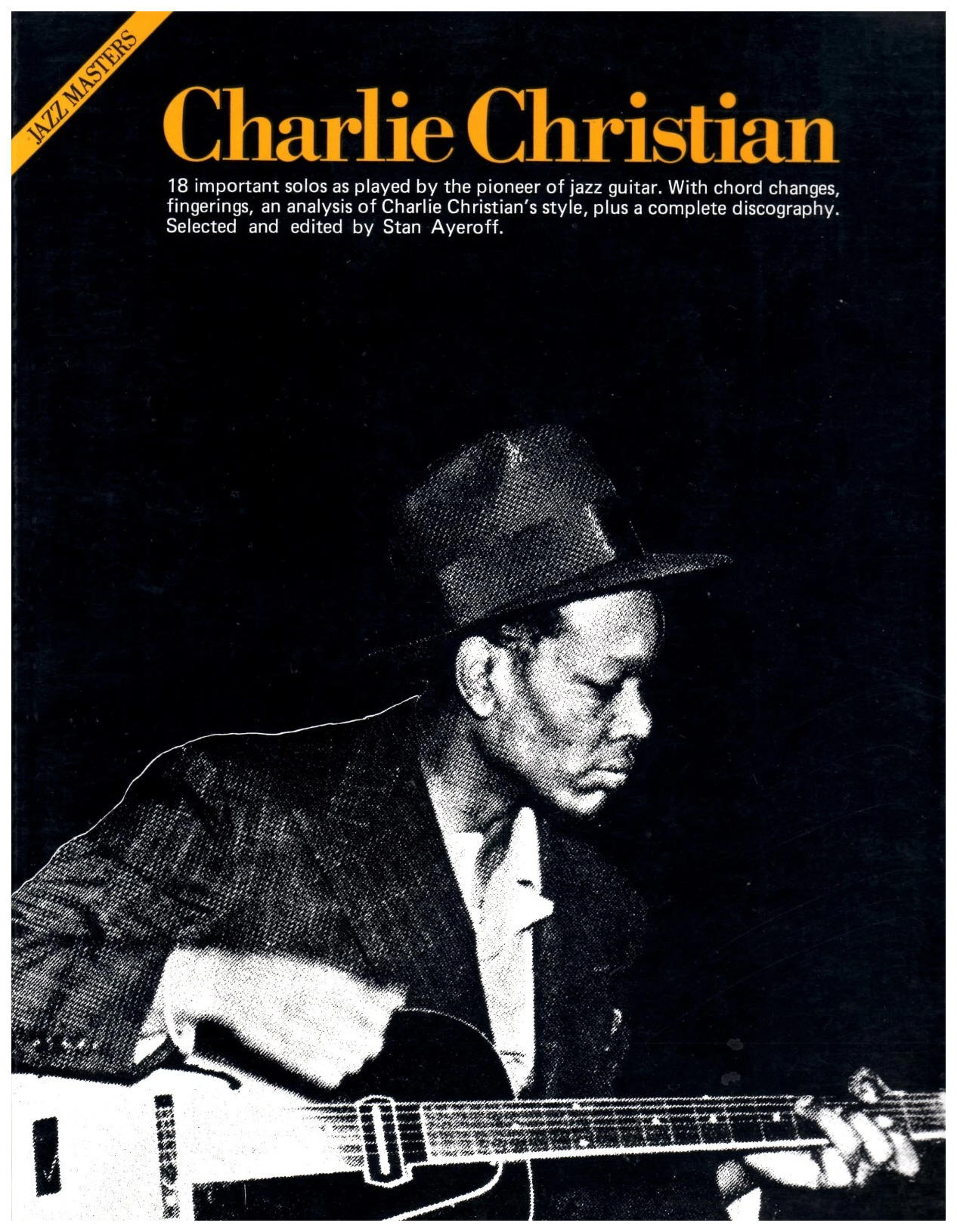
CHARLIE CHRISTIANJAZZ MASTERSCHARLIE CHRISTIAN
|
|
JAZZ MASTERS Charlie Christian
Stan Ayeroff
Consolidated Music Publishers New York 1979
Charlie Christian Because of the proliferation of electric guitars in today’s music it is difficult to imagine the excitement generated by the pioneers of the instrument. Though not the first to experiment with the electric guitar, Charlie Christian best understood its inherent possibilities and was the first person to inspire mass acceptance of the instrument. Charlie used the sustaining quality and increased volume of amplification to once and for all lift the guitar from its strict confinement in the rhythm section to the status of a lead horn or soloist.
Jimmy
Lunceford’s recording
of “Hittin’
the Bottle”
in September
1935 was probably the
first recording
utilizing any
guitar amplification.
The tune featured
Eddie Durham
(Lunceford’s
trombonist and
arranger) on
a
guitar with
a tin
resonator. In
Leonard Feather’s
Book of
Jazz, Durham
recalls: Lunceford was crazy about the resonator. He used to bring the microphone right up to the F-hole of the guitar, so that between that and the resonator it was almost like having an electric instrument. A year or two later, after the people that made the resonator had gone out of business, I found somebody else who was manufacturing an electrically amplified instrument I joined Count Basie’s band in the summer of 1937 and stayed with him a little over a year. Toward the end of that time I made two sessions with the Kansas City Five and Six, just a few guys out of the Basie band. with Freddie Greene playing rhythm guitar and myself on electric. …Touring with the band I ran into Charlie Christian in Oklahoma City. He was playing piano when I first saw him, but I never in my life heard a guy learn to play guitar faster than he did. It was around the latter part of 1937, and I’ll never forget that old beat-up, five-dollar, wooden guitar that he took to the jam session where I heard him play. ...I don’t think Christian had ever seen a guitar with an amplifier until he met me. It was a year before they got one on the market generally, and then he got one for himself.
Durham is represented in this book by the transcriptions “Good Morning Blues” and “Paging the Devil.” both recorded by the Kansas City Six. [Charles was the guitar soloist on both of those numbers – editor] It was early in the summer of 1939 that record producer and critic John Hammond stopped off in Oklahoma City to hear the 20-year-old Charlie Christian. He was on his way to California to supervise the first recording sessions Benny Goodman was making under a new Columbia contract – Hammond recollects his impressions in the August 25, 1966 issue of DownBeat:
He was carrying on his shoulders a pretty sad combo, including his brother and some other Texans, but the contrast between the never ending inspiration of Charlie and the mere competence of the others was the most startling I had ever heard. Before an hour had passed, I was determined to place Charlie with Benny Goodman, primarily as a spark for the depleted Goodman quartet.* It was as a member of the Goodman organization that Charlie gained wide popularity through recordings and radio broadcasts. ____________________________
*Teddy
Wilson and
Gene Krupa had left
to form
their own
bands.
The history of jazz guitar begins with the pioneering work of Lonnie Johnson and Eddie Lang. They were the first to develop a single-string technique and establish the guitar as a lead instrument. The great gypsy guitarist, Django Reinhardt, was the next great influence on the instrument. Django’s style was developed on acoustic guitar but he was not successful at making the transition to electric instruments, which he experimented with after World War Il The subtleties and nuances which he expressed on the acoustic instrument were lost on the electric. Charlie Christian was the first to develop a technique that was natural to the electric guitar instead of having to adapt an acoustic style. He was the sort of musician that inspires widespread imitation. You can hear his legacy in the playing of almost every guitarist who came after 1939. Why certain jazz styles are inimitable and some are not is an interesting question. Charlie Parker and Charlie Christian have many imitators who in turn spawn their own facsimiles. Others, like Thelonious Monk and Django Reinhardt, appear inimitable, though not because they were more individualistic. In Charlie Christian’s case. he laid the blueprint for his instrument’s future development by developing a highly idiomatic style. It is not solely as the progenitor of the electric guitar that Charlie Christian earned his fame in jazz history. Not content to play within the confines of the highly structured Goodman Orchestra and Sextet, Charlie was a frequent participant in the after-hours jam sessions that later led to the development of bebop. At Minton’s Playhouse in Harlem, men like Dizzy Gillespie, Charlie Parker, Thelonious Monk, and Kenny Clarke were leading the experiments that would later form a new music. Charlie was such a regular after-hours jammer that he left a spare amp at the club so he could just grab his axe and plug in after his regular gig. Fortunately, some of these sessions were recorded on home equipment, and the transcriptions of “Guy’s Got to Go,” “Lips Flips,” “Swing to Bop,” and “Up on Teddy’s Hill” show Charlie enjoying the freedom to play chorus after chorus with a never-ending drive and flow of ideas. It was a tragedy that the beacon that was Charlie Christian burned itself out so quickly. Dead of tuberculosis at the age of twenty-three, he was only on the scene for three years, yet he left his imprint forever in the development of the music he loved – jazz.
As Long as I Live A Benny Goodman Sextet number on which Charlie takes a solo on the middle eight bars of Cootie Williams’s trumpet solo.
Dinah A radio broadcast, by the sextet, of Lionel Hampton’s swinging arrangement with a full chorus by Charlie.
Good Morning Blues From the famous Carnegie Hall concerts of 1938/39 presented by John Hammond. The liner notes list Charlie as the electric guitar soloist along with Count Basie band members Lester Young, Buck Clayton, Freddie Greene, Walter Page, and Jo Jones under the name of the Kansas City Six. In corresponding with Milt Gabler, who actually recorded the concerts, I was informed that Basie trombonist and arranger Eddie Durham was in fact the electric-guitar soloist with the Kansas City Six. The recording was made in 1938 which precedes the recording debut of Charlie Christian by one year. [The guitar soloist was, indeed, Charles, on December 24, 1939 – editor]
Guy’s Got to Go From a jam session taped by jazz enthusiast Jerry Newman at Clark Monroe’s Uptown House in 1941. Monroe’s, along with Minton’s Playhouse, provided the space in which musicians could develop and test out new ideas about music. It was at jam sessions like this that the music later known as bebop emerged. This tune was named after trumpeter Joe Guy, a member of the house band at Minton’s and a frequent participant in the sessions. The recordings were made on primitive equipment and the quality is poor. Originally issued on the Esoteric label, the engineers edited heavily, making many splices and adjustments to remove unwanted noise. In this particular song the editing has created some strange moments. In measure 16 there are two beats missing, creating a 2/4 measure. Measure 33 has one extra quarter note (Bb) creating a 5/4 measure.
Honeysuckle Rose (l) Charlie takes a full chorus in the Goodman Orchestra’s performance of Fletcher Henderson’s big-band arrangement.
Honeysuckle Rose (II) Charlie takes a chorus on a radio broadcast by the Benny Goodman Septet.
Honeysuckle Rose (III) This version, by the sextet. is from the 1939 Carnegie Hall concert presented by John Hammond.
I Can’t Give Anything but Love The septet performance of this old standard features Charlie on a half chorus.
Ida, Sweet as Apple Cider A radio broadcast of the septet with a full chorus by Charlie.
I Surrender Dear A sextet recording with a half chorus by Charlie.
I Found a New Baby (I) The septet with a chorus by Charlie.
I Found a New Baby (Il) An alternate take.
Lips Flips Another jam session recording, named after trumpeter and vocalist Hot Lips Page.
Paging the Devil Another recording of the Kansas City Six probably featuring Eddie Durham rather than Charlie on electric guitar. [The guitar soloist was Charlie Christian, on December 24, 1939 – editor]
The Sheik of Araby (I) Sextet recording with a chorus by Charlie.
The Sheik of Araby (Il) An alternate recording of a radio broadcast.
Stardust (I) This transcription covers the first chorus of a privately-cut recording (made by a disc jockey during a live performance in a Minneapolis club in March 1940). The second chorus (which I have transcribed as “Stardust (II)”) is a planned solo performed almost note for note on CBS 62 581 recorded on October 2, 1939, and Musidisc 30 JA 5181 recorded on October 9, 1939. [The Minneapolis date took place on September 24, 1939, recorded by Jerry Newhouse (not a disc jockey) – editor]
Stardust (II) CBS 62 581 recording of Charlie’s version of this standard which greatly impressed Benny Goodman.
Swing to Bop Another jam session on which Charlie really gets a chance to stretch out. The transcription starts on the first bridge.
Up on Teddy’s Hill Named for bandleader Teddy Hill who became the manager of Minton’s, this jam session tune is based on the chord progression of “Honeysuckle Rose.”
A Note on the Fingering I have attempted to use those fingerings that were most facile while producing the desired sound. There are many choices of which these are the ones that worked best for me. The reader may find that another fingering suites his particular technique better than the one I have chosen. If so, feel free to experiment.
A Note on Swing In all the transcriptions, eighth notes are to be played in a swing manner. This means that two eighth notes are to be played as the first and third notes of a triplet. If the words straight rhythm are written above a series of notes, play them without a swing feel (as written).
A Guide to the Charlie Christian Guitar Style Although it is not the intention of this book to deal extensively with basic chord construction and counterpoint, this section presents several positions and concepts used most often throughout the solos that follow. This should serve as an aid to understanding and playing the music of Charlie Christian. The reader is strongly encouraged to fill in any gaps with supplementary instruction and reading.
Playing through Changes Charlie Christian was a master at playing through a series of chords, often a cycle of 5ths type of progression. He did this by connecting the various positions illustrated in a smooth and exciting manner. He often anticipated the approaching chord during the previous one creating a feeling of great drive. Throughout the solos you will find extensive use of the interval of the tritone (#4th) to chromatically connect a series of 7th chords.
Discography
The following is a discography of Charlie Christian’s recorded output. Some albums are imports and some arc out of print. Either write the record company or look in the vintage jazz section of your nearest major record store (or one that specializes in rare and out-of-print jazz albums).
Solo Flight – The Genius of Charlie Christian Columbia CG30779, John Hammond Collection.
“As
Long as
I
Live,”
“Honeysuckle Rose
(l),”
Charlie
Christian Columbia CL 652.
Solo
Flight – Charlie Christian CBS (Columbia), Aimez Vous le Jazz no. 3, 62 581 (Printed in Holland)
“As Long as I
Live,” “Honeysuckle Rose
(I),”
John Hammond’s
Spirituals to Swing – Vanguard VRS 8523/4
“Good
Morning Blues,”
“Honeysuckle Rose
(III),
Charlie Christian – Archive of Folk Music - Jazz Series Everest FS-219
Write
for information to
Everest Records,
“Guy’s
Got
to
Go,” “Lips
Flips,”
Charlie Christian Live 1939-1941 Jazz Anthology Musidisc 30 JA 5181. (Printed in France)
“Dinah,” “Honeysuckle
Rose (II),”
|
|
This book has been selected for inclusion here because it has often been cited by other writers, critics, and transcribers and also because it was one of the first CC instruction / transcription books published. Ayeroff later published another book, in 2005, with twice as many transcriptions including those in this earlier assemblage. |
[ Discography Index ] [ Tune Title Index ]
|